Wall Street opened the week on the back foot as a slide in chipmakers ahead of Nvidia’s earnings dragged the S&P 500 lower, while Treasury Secretary Scott Bessent unveiled a sweeping sanctions campaign aimed at cutting Iran off from the global economy.
Oil settled near $85 as the energy market weighed the threat of secondary sanctions against Iran’s trading partners, long-end yields eased, gold climbed to its highest in more than three months, and bitcoin extended its rebound toward $79,000. The dollar firmed against every major and finished as the day’s strongest currency.
Check out the forex news and economic updates you may have missed in the latest trading session!
News Headlines & Data:
Broad Market Price Action:
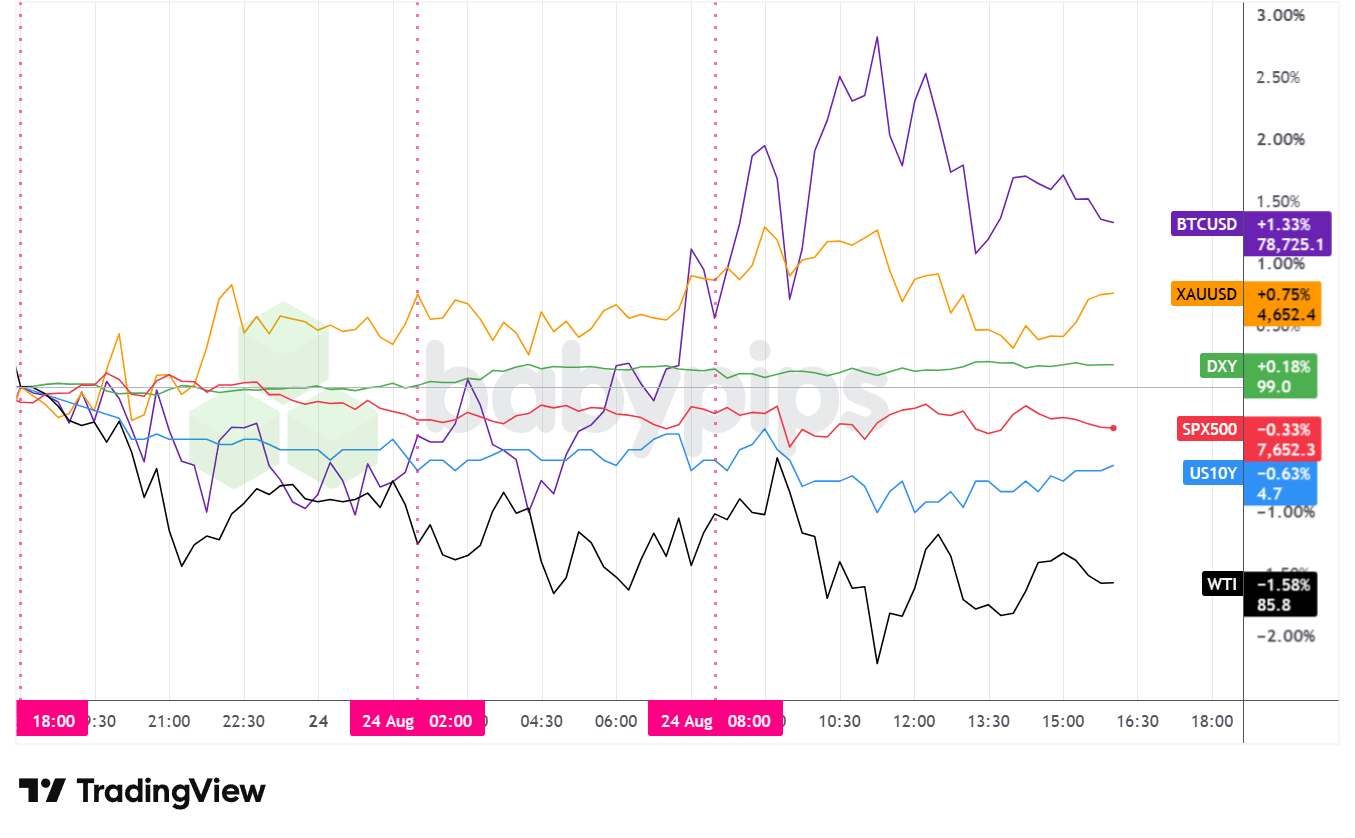
Dollar Index, Gold, Oil, S&P 500, U.S. 10-yr Yield, Bitcoin Overlay – Chart Faster With TradingView
Monday ran on two threads: a chip-led pullback in stocks ahead of Nvidia’s results and Bessent’s midday press conference on Iran. The dollar firmed, oil slipped despite the sanctions threat, and long-end yields drifted lower, while gold and bitcoin both pushed higher into the close.
The S&P 500 traded near 7,670 through the overnight hours before sliding after the U.S. open, dropping toward a low near 7,640 in the late morning and clawing back to close near 7,653, off roughly 0.33% on the day. A selloff in semiconductor names did much of the damage, with Nvidia sliding for a seventh straight session ahead of its earnings later in the week. A news report that some of the company’s largest customers had been warned of AI-related price hikes above 15% added to the anxiety, and memory-chip shares fell hard alongside the broader group.
Oil spent much of the session drifting lower. WTI traded near $86.50 overnight, pushed up toward $87 around the London morning, then rolled over through the U.S. session to settle near $85.80, down around 1.58% on the day. Bessent’s threat of economic punishment against any country doing business with Iran did little to lift crude, and it’s possible the market had already priced much of the announcement after a week of advance signaling.
Treasury yields eased as energy costs came off. The U.S. 10-year traded near 4.72% overnight before drifting lower through the U.S. session to finish near 4.70%, down roughly 0.63% on the day. The softer read on oil likely removed some inflation pressure from the long end, and Bessent held off on further signals about revamping U.S. debt management after last week’s surprise plan to boost buybacks of longer-dated bonds.
Gold chopped through a wide range and closed higher. The metal traded near $4,620 overnight, dipped toward $4,595 in the early hours, then climbed through the London and U.S. sessions to a high near $4,681 before settling near $4,653, up around 0.75% on the day and its highest level in more than three months. The firmer dollar worked against bullion, but the unresolved Iran risk and steady haven demand potentially offered enough support to keep the rally intact.
Bitcoin extended its recovery and outperformed. It held near $77,000 overnight before pushing higher from the London morning, clearing $79,000 and reaching a high near $79,995 before easing back to close near $78,700, up around 1.33% on the day. With no crypto-specific catalyst driving the move, the rebound possibly drew support from the day’s softer tone in long-end yields and a broader appetite for assets outside the struggling equity complex.
Promoted: A Chip Selloff, an “Economic D-Day,” and a Dollar on the Move. Is Your Capital Ready?
Sessions like Monday’s, with semiconductors sliding into Nvidia’s earnings and Bessent’s Iran sanctions rippling across oil and currencies, reward traders who can act on news events without second-guessing their account size. FundedNext empowers disciplined traders by providing simulated trading accounts up to $200K.Unlike other prop firms, FundedNext imposes no artificial time limits on challenges. You even earn a unique 15% profit share during your evaluation! Once funded, you keep up to a 95% profit split with guaranteed 24-hour payouts. Trade CFDs or Futures your way, even during major news events.
Join over 400K traders who have received $300M+ in payouts. Ready to back your edge?
Learn More About FundedNext! Limited time offer: Use code BP for discounts on both CFD & Futures plans! T&C apply.
Disclosure: We may earn a commission from our partners if you sign up through our links, at no extra cost to you.
FX Market Behavior: U.S. Dollar vs. Majors
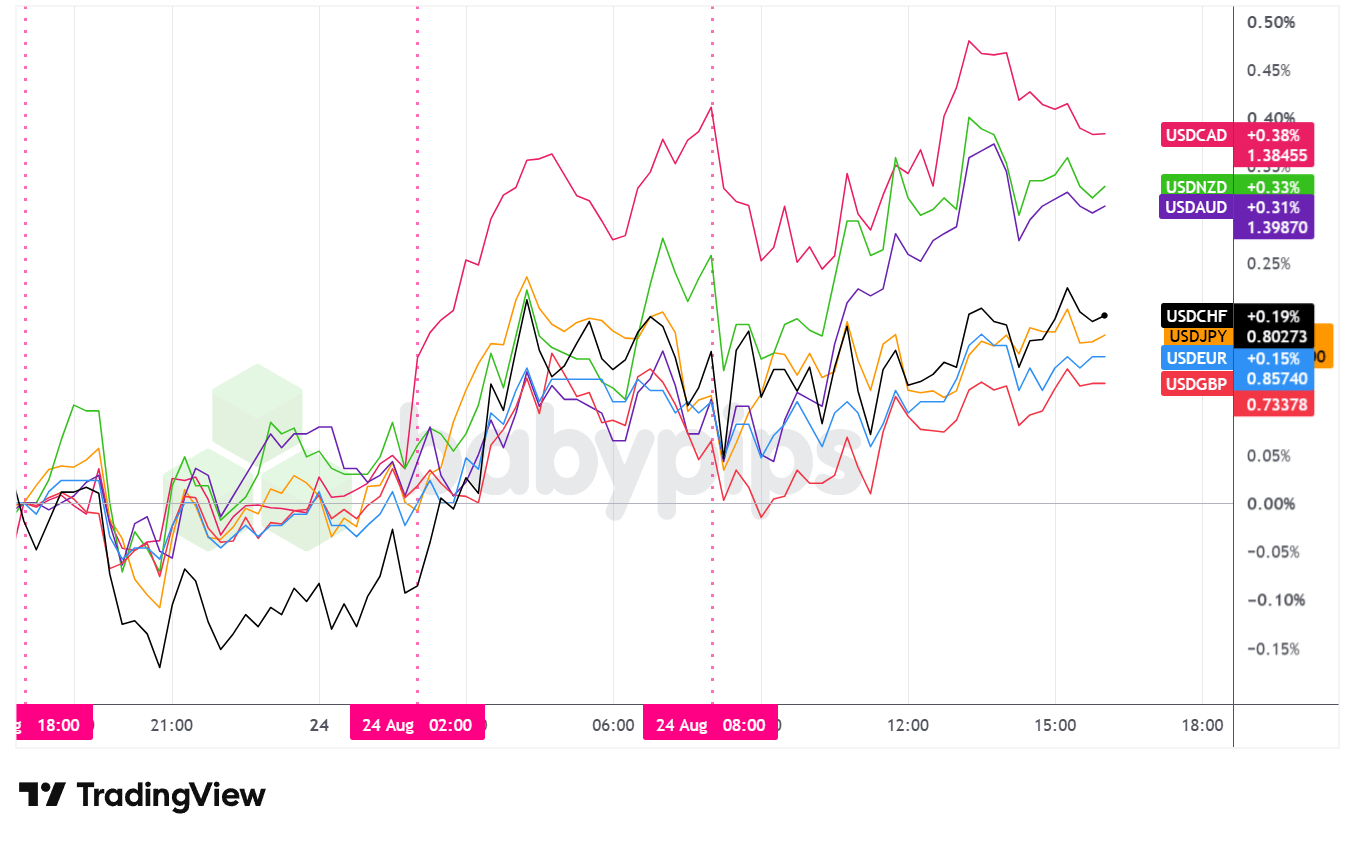
Overlay of USD vs. Major Currencies – Chart Faster With TradingView
The Dollar Index finished higher, near the 99.01 area, up around 0.18% on the day. The greenback gained ground against every major and closed as the strongest currency in the group, with the Canadian dollar the weakest as fresh U.S.-Canada trade tension deepened the loonie’s slide.
From the Monday Asia open, the dollar dipped, stabilized, and then rebounded against the majors, leaning net bullish heading into the London open. USD/CAD opened higher with a weekend gap after U.S.-Canada trade talks stalled, with Canadian officials seeing little prospect of negotiations resuming before the U.S. midterm elections and preparing financial support for affected businesses. New Zealand retail sales contracted 0.5% in the second quarter, the first quarterly decline since Q3 2024, ahead of the RBNZ’s September 2 meeting.
After the London session opened, the dollar continued to move higher against the majors, stabilizing through the mid-London morning and trading choppy before pulling back slightly heading into the U.S. open. The European session was quiet on the data front, with no major releases. ECB policymaker Piero Cipollone said eurozone inflation remained far from the central bank’s adverse scenarios, though the comment gave the dollar no decisive push in either direction.
After the U.S. session opened, the dollar stabilized once more and then rebounded against the majors through the rest of the day. Attention centered on Bessent’s 2:00 p.m. ET press conference, at which he unveiled the Iran sanctions campaign, and it’s possible much of the announcement was already reflected in prices given the week of advance signaling. The Chicago Fed National Activity Index came in at -0.08 against a 0.1 forecast, a soft regional read that drew little market reaction.
At the Monday close, the dollar was the best performing major currency on the day. The outcome fit a session of easing long-end yields and a broad pullback in risk appetite, with the greenback drawing haven flows as equities leaked lower and trade tension pressed on the Canadian dollar.
Upcoming Potential Catalysts on the Economic Calendar
- Australia RBA Meeting Minutes at 1:30 am GMT
- Australia RBA Jacobs Speech at 4:00 am GMT
- Japan Leading Indicators Index for June 2026 at 5:00 am GMT
- Germany GDP Growth Rate Final for June 30, 2026 at 6:00 am GMT
- Germany Ifo Business Climate for August 2026 at 8:00 am GMT
- U.S. Building Permits Final for July 2026
- U.S. Fed Barkin Speech at 12:00 pm GMT
- U.S. ADP Employment Change Weekly for August 8, 2026 at 12:15 pm GMT
- Canada Wholesale Sales Prel for July 2026 at 12:30 pm GMT
- U.S. S&P/Case-Shiller Home Price for June 2026 at 1:00 pm GMT
- U.S. House Price Index for June 2026 at 1:00 pm GMT
- U.S. Richmond Fed Manufacturing Index for August 2026 at 2:00 pm GMT
- U.S. New Home Sales for July 2026 at 2:00 pm GMT
- U.S. CB Consumer Confidence for August 2026 at 2:00 pm GMT
- U.S. Money Supply for July 2026 at 5:00 pm GMT
- U.S. Fed Barkin Speech at 8:00 pm GMT
- U.S. API Crude Oil Stock Change for August 21, 2026 at 8:30 pm GMT
Tuesday’s calendar leans on European sentiment surveys and a run of second-tier U.S. data, which means the fallout from Bessent’s Iran campaign and the approach of Friday’s Jackson Hole gathering will likely stay in the driver’s seat for cross-asset direction.
Germany’s Ifo business climate and final GDP offer fresh reads on the euro area, while U.S. consumer confidence, new home sales, and the Richmond Fed manufacturing index give near-term signals on the domestic backdrop. RBA meeting minutes and a speech from the bank’s Jacobs could add cross currents for the Aussie early in the session.
Stay frosty out there, forex friends!
When equities slide, oil eases, bonds ease, and the dollar strengthens all in the same session, most traders see separate events. But they’re all connected through a single shift in market sentiment. Premium members can read our lesson:
📖 What Is Intermarket Analysis?
Reading this helps you understand how risk-on and risk-off sentiment moves stocks, bonds, commodities, and currencies together, and why recognizing that correlation tells you which way currency pairs will break before price ever shows it on the chart.
And if you’re not a Premium subscriber yet, now’s a good time to join.
With Babypips Premium, you get full access to School of Pipsology lessons that help you understand not just what’s moving on your chart today, but the cross-asset mechanism that’s actually driving it.