The European Central Bank kept its deposit facility rate (the rate the ECB pays commercial banks for overnight deposits, which anchors borrowing costs across the eurozone) at 2.25% on Thursday.
Nobody was surprised. Markets had priced in a greater than 99% probability that the ECB would leave rates unchanged.
Yet EUR/USD still slipped 0.28% to 1.1378 that day.
That highlights one of the most important things to understand about ECB meetings. The rate decision usually isn’t the main story. The press conference is.
Why Does the Press Conference Move the Market More Than the Rate?
By the time a central bank announces its decision, traders have usually already factored it into prices. They’ve had weeks of speeches, economic data, and rate futures positioning to work with before anyone steps into that Frankfurt press room.
In other words, the number itself is often old news.
What traders can’t fully price in advance is how the ECB will talk about what happens next.
After the announcement, President Lagarde reads a prepared statement, answers questions, and carefully explains how the Governing Council views the economy. That’s where the real information comes through.
Traders are mainly listening for two things.
The first is forward guidance, or clues about where monetary policy may be heading.
The second is any change in how the ECB describes inflation risks, or whether officials think prices are more likely to run hotter or cooler than expected.
Even a small change in wording can move German Bund yields several basis points before a reporter has finished asking the question.
The July 23 press conference delivered three clear signals.
Promotion: TradeZella’s new AI trading partner can break down and analyze your trades & build a game plan, freeing up time and energy to focus on the next moves!
Start Your Trading Journey with Tradezella & use code “PIPS20” for 20% off your first purchase!
Disclosure: To help support our free daily content, we may earn a commission from our partners if you sign up through our links, at no extra cost to you.
What Did Lagarde Actually Signal?
 The clearest signal came from a change in the ECB’s language.
Officials now describe inflation risks as “tilted to the upside.” Previously, they called those risks “more balanced.”
That may sound like a minor edit, but it carries a clear message. If the ECB’s next move is a change in rates, a hike now appears more likely than a cut.
The vote delivered another signal.
The decision to hold was unanimous, but Lagarde acknowledged that several Governing Council members had “asked themselves” whether the ECB should have raised rates on Thursday.
A unanimous vote doesn’t necessarily mean the council agrees on everything. It simply means enough members decided that waiting was the right choice for now.
Lagarde then summed up the ECB’s approach with one line: “The burden of proof is on data.”
Both hawks, who favor higher rates, and doves, who would rather keep policy unchanged, need evidence to support their position.
But context matters. With oil near $100 per barrel and eurozone inflation running at 2.8%, well above the ECB’s 2% target, the data may now need to make a stronger case for holding rates than for raising them.
Analysts also noticed a quieter shift in the ECB’s language. The bank removed its previous reference to “monitoring” the war. Some believe it’s a sign that they will hike in September, regardless of how the conflict develops.
But there was one dovish caveat.
Lagarde said the ECB still hasn’t seen significant second round effects. That’s when higher energy prices begin feeding into wages and broader prices, causing inflation to spread beyond the original shock.
This qualifier matters because wage data begin showing stronger second round effects before September 10, it would become much harder for the ECB to argue against another hike.
Then Why Did the Euro Fall?
Hawkish central bank signals normally support a currency because higher expected interest rates can attract capital from investors looking for better yields.
So at first glance, a hawkish ECB press conference followed by a weaker euro looks contradictory.
The explanation was on the other side of EUR/USD. See, Thursday’s session was dominated by broad U.S. dollar strength.
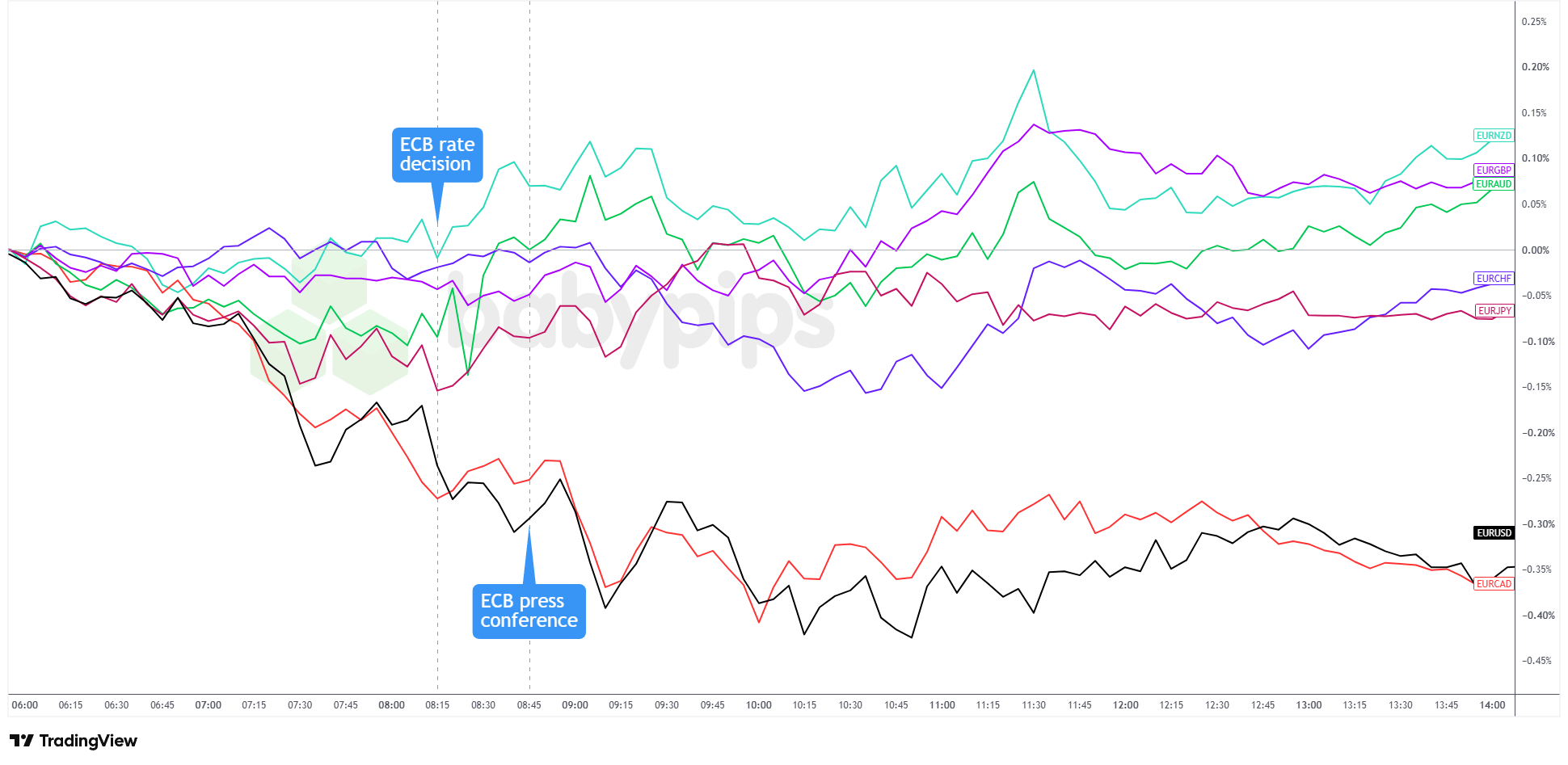
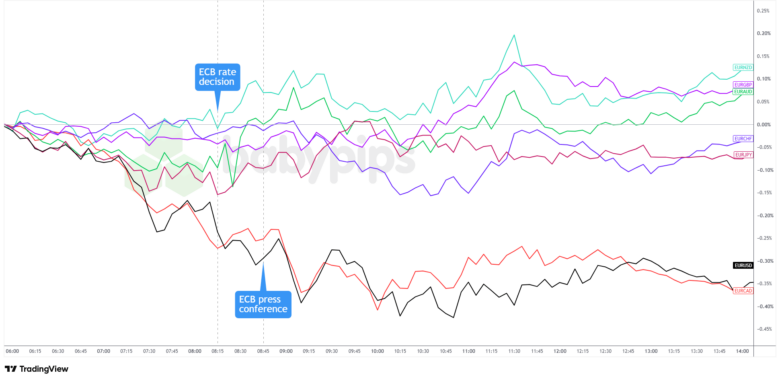
EUR 5-min Forex Charts – Chart Faster with TradingView
The escalating conflict between the U.S. and Iran pushed WTI crude above $90 per barrel. That helped drive U.S. Treasury yields to their highest levels since January 2025, with the 10 year yield reaching 4.71%.
Markets then raised the probability of a Federal Reserve rate hike in September to roughly 82%, up from around 53% a week earlier.
So, it’s not that the ECB didn’t disappoint markets. It’s just that the dollar had more momentum.
This is why currency moves need to be viewed from both sides of the pair, not just through the lens of one central bank.
What Does This Mean for EUR Heading Into September?
The ECB’s September 10 meeting will carry more weight than July’s widely expected hold because officials will also release updated economic projections.
If oil prices stay elevated and Euro Area inflation expectations remain high, those forecasts could support a 25 basis point hike, lifting the deposit rate from 2.25% to 2.50%. Markets are already pricing in two more hikes by year end.
So, the question may no longer be what would make the ECB hike in September, but what could stop it.
Energy is the biggest wild card. A sustained drop in crude prices, perhaps after a ceasefire or the reopening of the Strait of Hormuz, could push the ECB toward another hold, lower rate expectations, and weigh on the euro.
Until September 10, traders will be watching oil prices, inflation, wages, and ECB speeches. For EUR/USD, developments in the Persian Gulf may matter more than anything said in Frankfurt.
Quick Takeaways
- The ECB held its deposit facility rate at 2.25% on July 23 in a unanimous decision, with a September hike now broadly anticipated by money markets.
- Sometimes, central bank press conferences move currencies more reliably than the rate decision itself. Shifts in inflation risk language and internal council dynamics carry the real signal.
- A hawkish hold means the central bank pauses but signals tighter policy ahead. Thursday’s ECB meeting fits that description.
- EUR/USD can fall even on hawkish ECB signals when the dollar is running harder on its own drivers. Always read both sides of the pair.
- September 10 is the real decision meeting. Oil prices between now and then may be the single most important variable.
What Should You Watch For?
ECB Chief Economist Philip Lane speaks today, July 24, at 3:30 p.m. GMT. His remarks will offer the first official clues about how the ECB is framing the path toward September.
The ECB’s June Consumer Inflation Expectations report is also due today at 8:00 a.m. GMT.
Both events arrive before the U.S. session opens and could move EUR/USD. However, the September 10 ECB meeting remains the key date to watch.
The ECB held rates at 2.25% in July 2026, but it was Lagarde’s press conference language that moved EUR/USD. Readers new to central bank signals may find the shift in the ECB’s inflation risk wording hard to interpret. Premium members can read our lesson:
📖 Hawkish vs. Dovish: How to Read Central Bank Language
Reading this helps you understand how hawkish and dovish signals work, why a single press conference can move currencies more than the rate decision itself, and how to identify where a central bank stands on the policy spectrum.
And if you’re not a Premium subscriber yet, now might be a good time to sign up.
With Babypips Premium, you get full access to School of Pipsology lessons that help you understand not just what the ECB decided, but the hawkish and dovish language shifts in Lagarde’s press conference that actually drove the move in EUR/USD.