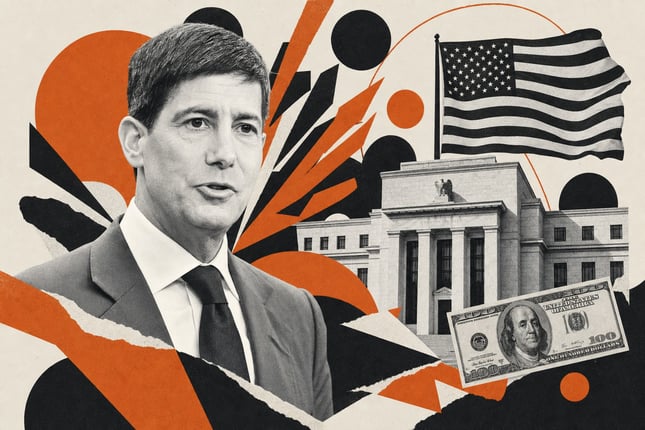

While everyone obsesses over the possibility of a quarter-point interest rate hike, the U.S. government keeps adding to its massive $40 trillion debt.
The Trump administration ran a $166.8 billion deficit in August, according to the Monthly Treasury Statement. That drove the fiscal 2026 budget shortfall to $1.97 trillion, virtually the same as through the same period last year.
To put the numbers into perspective, for every dollar the federal government has received in revenue this year, it spent $1.41, meaning 28.9 percent of fiscal ’26 federal outlays have been paid for with borrowed money.
The August deficit was significantly (52 percent) lower than the August 2025 deficit, and many mainstream media outlets breathlessly reported it as a “shrinking” deficit. But calendar shifts skew the numbers.
When accounting for August spending pushed back into July, driving the biggest monthly budget shortfall since the COVID era, the August deficit rises to $248 billion, $7 billion higher than August 2025.
Uncle Sam also enjoyed the benefits of lower tariff refunds, boosting August revenue.
Total government receipts came in at $360.03 billion. That included a net $12.84 billion in tariff receipts. It was the first month of positive tariff revenue since April.
Tariff refunds totaled $10.54 billion, down from $33.38 billion in July.
With one month remaining in fiscal 2026, total government receipts stood at $4.85 trillion. That’s 3.3 percent higher than through the same period in 2025.
The real problem continues on the spending side of the ledger.
The Trump administration blew through $526.83 billion last month, even with some August Social Security and Medicare payments going out in July. Factoring in the calendar effects, the federal government spent around $608 billion last month, slightly lower than the $689 billion spent in August 2025 (another month impacted by calendar effects).
With one month remaining, the Trump administration has spent $6.81 trillion, a 2.2 percent increase over the same period in 2025.
A 2.2 percent increase in spending might not sound significant. But weren’t we told there would be spending cuts?
In fact, there were some cuts in the Big Beautiful Bill (along with spending increases).
The increased spending comes despite cuts to the EPA and the Department of Education, along with staffing reductions that are now showing up in the data. Lower disaster spending also helped moderate spending levels through the first two months of fiscal ’26.
Looking at the big picture, the spending trajectory is up. Even with all the hype about DOGE and some lip service to cutting spending during the early days of the Trump administration, the U.S. government spent just over $7 trillion last year. That’s an average of $583.3 billion per month or $19.2 billion per day.
And now there’s a war.
According to the latest CBO forecasts (which tend to assume best-case scenarios), net outlays will run at $7.449 trillion in FY2026, $7.772 trillion in FY2027, and $8.151 trillion in FY2028.
Despite some non-specific talk about “spending cuts,” there seems to be little to no commitment to tackle runaway spending. In fact, the powers-that-be constantly find new reasons to spend money, whether it is a crisis at home or a war overseas.
The cost of the debt
The federal government got a little relief in the form of lower interest expense in August.
In August, the Treasury forked out $97.7 billion in gross interest on Treasury debt securities. That was down from $117.57 billion in July.
According to a Treasury Department official, the drop in interest expense reflected changes in inflation accruals.
August interest payments pushed total interest expense to $1.27 trillion with one month remaining in fiscal ‘26. That’s up about 13 percent compared to the same period in fiscal ’25.
Interest on the national debt cost $1.2 trillion in fiscal 2025. That was up 7.3 percent over 2024.
Net interest outlays (interest expense – interest receipts) were $86 billion in August.
Through the first 11 months of the fiscal year, the federal government spent more on interest on the debt than it did on national defense ($876 billion) or Medicare ($979 billion). The only higher spending category is Social Security ($1.5 trillion).
Much of the debt currently on the books was financed at very low rates before the Federal Reserve started its hiking cycle. Every month, some of that super-low-yielding paper matures and must be replaced by bonds yielding much higher rates.
This brings us back to all the hoopla over a possible Federal Reserve rate hike. Everybody is obsessing about what Warsh & Co. may or may not do and ignoring the $40 trillion elephant in the room. Quite frankly, the next $1 trillion in debt is almost certainly more significant than a quarter-point hike in rates.
And when you combine an ever-growing Debt Black Hole with rising rates, you have a recipe for real trouble – which is precisely why I think even if the Fed does hike, it will be one-and-done.
If only people worried as much about the debt as they do the mechanizations of the central bank, maybe we could make some headway.
But that doesn’t seem to be in the cards.
When people say the spending is unsustainable, it feels like an understatement. In fact, it’s fair to call the federal government insolvent.
However, very few people in the political class seem the least bit interested in tackling the problem. The bad news is that at some point, the problem is going to tackle them.