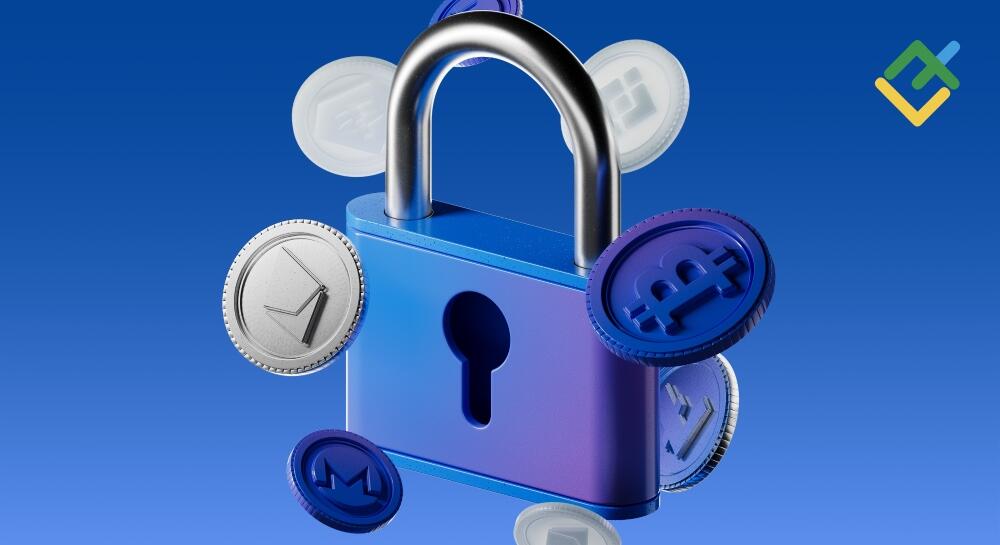
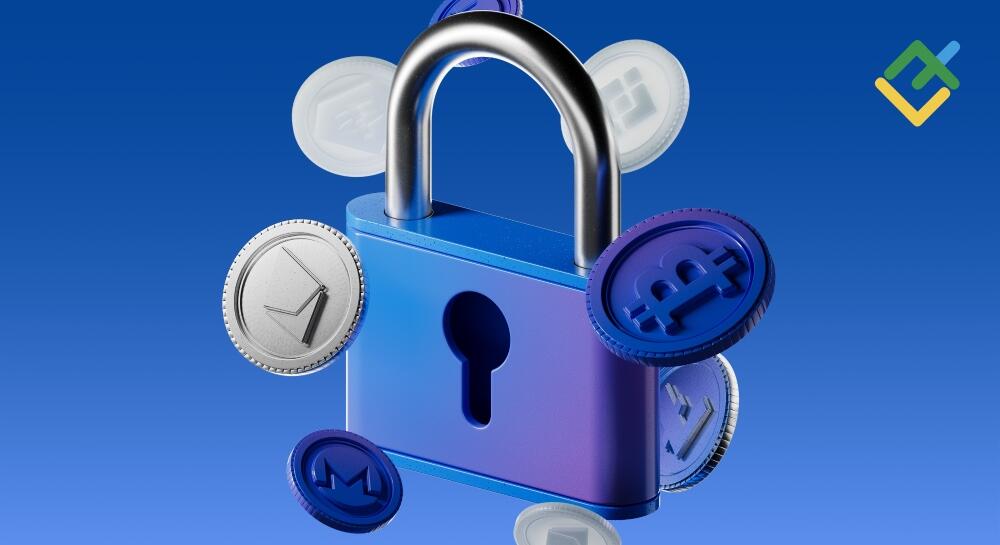

Imagine withdrawing cash from an ATM. Once you have the money, neither the bank nor anyone else can track how you spend it. Most cryptocurrencies work differently. Their transactions are recorded on a public blockchain, allowing anyone to view your wallet history with a blockchain explorer. Privacy coins are designed to protect financial privacy by concealing transaction details.
However, this level of privacy comes at a cost. Privacy coins are under growing regulatory scrutiny, and buying or using them requires caution. That is because governments do not want to lose control over the flow of money.
The article covers the following subjects:
Major Takeaways
- Privacy coins are cryptocurrencies that obscure transaction data.
- Unlike Bitcoin and Ethereum, where transaction histories are publicly visible, privacy coins make it virtually impossible for outside observers to trace transactions.
- The three main privacy technologies are ring signatures, stealth addresses, and zero-knowledge proofs (zk-SNARKs). Dash uses coin mixing, but it does not provide the same level of anonymity as other privacy technologies.
- Privacy coins are legal in most countries, but crypto exchanges are increasingly delisting them due to regulatory pressure and money laundering risks.
- The biggest risk with privacy coins is regulation. In some jurisdictions, using them may attract additional scrutiny from regulators.
- Demand for financial privacy is growing worldwide, and developers are working to balance anonymity with regulatory requirements through selective data disclosure.
What Are Privacy Coins?
Privacy coins are a type of cryptocurrency designed to maximize financial privacy. In conventional blockchains such as Bitcoin, every transaction is recorded on a public ledger. Anyone can see how many coins were transferred, as well as the sender’s and recipient’s wallet addresses. While this transparency is one of Bitcoin’s defining characteristics, many users consider it a disadvantage.
Anonymous cryptocurrencies work differently. They use cryptographic techniques to conceal transaction details, making them visible only to the sender and recipient. To everyone else on the network, a transaction appears as “someone sent something to someone,” without revealing who sent what, to whom, or how much.
Like other cryptocurrencies, privacy coins retain the core benefits of blockchain technology, including decentralization, fast transactions, low fees, and no intermediaries. Transactions are still verified by miners or validators, but their details remain hidden.
It is important to distinguish between application-level and protocol-level privacy. For example, cryptocurrency mixers provide application-level privacy, requiring users to trust the mixing service. Privacy coins, by contrast, build anonymity directly into the protocol.
How Do Privacy Coins Work?
Privacy coins rely on three core technologies. Each protects a different aspect of a transaction by hiding the sender, the recipient, or the amount transferred. The most advanced privacy coins combine these technologies to provide multiple layers of privacy.
Ring Signatures
This technology hides the sender of a transaction. When a payment is made, the sender’s digital signature is combined with the signatures of other network participants, forming a “ring” of signatures that obscures the true initiator of the transaction.
Monero uses ring signatures that combine a user’s signature with several randomly selected previous transactions from the blockchain, making it impossible to identify the true source of the transaction.
The more participants in the ring, the higher the level of user anonymity. By default, Monero uses a ring of 16 participants, making transactions significantly more difficult to trace.
Stealth Addresses
This technology conceals the recipient of a transaction. A unique, one-time address is generated for every transfer. Even if you send coins to the same person 100 times, each transaction is sent to a different address.
This makes it virtually impossible to link all of those transactions to a single recipient.
Zero-Knowledge Proofs (zk-SNARKs)
This is one of the most advanced privacy technologies available today. It allows transactions to be verified without revealing the amount, the sender, or the recipient.
Instead of transaction details, the blockchain records a cryptographic proof that mathematically verifies the transaction was executed correctly.
Generating a zk-SNARK proof requires significant computational power, but verifying it takes only a fraction of a second. This makes the technology well suited for scaling, although it is more computationally demanding than ring signatures.
Ring Confidential Transactions (RingCT) in Monero hide the amount being transferred. Some cryptocurrencies, such as Monero, enable privacy by default. Others, such as Zcash, let users choose whether to hide transaction details. This approach, known as optional privacy, offers greater flexibility but requires users to know when to enable these privacy features.
Top Privacy Coins
If you are looking for anonymity-enhanced cryptocurrencies, three main projects stand out in the market. Each of them takes its own approach to ensuring financial privacy and has its own advantages.
Monero (XMR) — Absolute Privacy
Monero is widely regarded as the benchmark for anonymity-enhanced cryptocurrencies. Privacy is built into the network by default. Every transaction uses ring signatures, stealth addresses, and Confidential Transactions (RingCT).
Monero also uses Bulletproofs to reduce transaction sizes and speed up verification. This improves network efficiency and helps the blockchain scale more effectively.
Zcash (ZEC) — Optional Privacy
Zcash uses zk-SNARKs to enable private transactions. Its key feature is optional privacy. Users can choose between transparent transactions, similar to those on Bitcoin, and private transactions. On the blockchain, transparent addresses begin with t, while private addresses begin with z.
Moreover, Zcash provides selective disclosure. Users can share a special viewing key with an auditor or regulator to reveal the details of a specific transaction without exposing their entire transaction history. This makes Zcash better suited to the compliance requirements of financial institutions.
Dash (DASH) — Speed and Convenience
Dash was created as digital cash for everyday payments. To enhance privacy, it uses PrivateSend, a feature that mixes coins from multiple users to obscure their origin. While it does not offer the same level of privacy as Monero, it provides enough anonymity for most everyday transactions.
Dash also supports instant transactions through InstantSend and uses a self-funded governance model. These features make it one of the most practical cryptocurrencies for everyday use.
Are Privacy Coins Legal?
Privacy coins remain legal in the US, the EU, Canada, and most countries. However, they continue to face close regulatory scrutiny due to concerns about money laundering and terrorist financing.
As a result, many major cryptocurrency exchanges delisted Monero and other privacy coins in 2024 and 2025. Japan and South Korea have banned privacy coin trading, while European regulators require crypto exchanges to take a risk-based approach when handling these assets.
In 2025, international cooperation on cryptocurrency regulation intensified. The European Union introduced MiCA, a regulatory framework that sets clear rules for the crypto industry. At the same time, law enforcement agencies increasingly rely on blockchain analytics tools to track suspicious financial transactions, including those involving privacy coins.
Important! Privacy coin holders must comply with local KYC and AML requirements when transferring funds to cryptocurrency exchanges or using exchange services. Full anonymity is only possible within the blockchain network. Once funds enter the traditional financial system, identity verification is usually required. In some countries, failing to declare privacy coins may result in administrative or criminal penalties.
How to Buy Privacy Coins
Although privacy coins are not as widely available as Bitcoin or Ethereum, they can still be purchased through several channels:
- Centralized exchanges (CEX). Some major cryptocurrency exchanges still list privacy coins. To buy them, however, you must complete identity verification (KYC). The exchange knows your identity and records your transactions. While this reduces financial privacy, it offers greater convenience, liquidity, and security.
- Decentralized exchanges (DEX). Platforms such as Bisq and Haveno allow users to trade privacy coins without identity verification. Transactions take place directly between buyers and sellers. This provides greater financial privacy and independence, although liquidity is lower, fees are often higher, and there is no central party to resolve disputes.
- P2P platforms and exchange services. Some platforms connect buyers and sellers directly. The two parties agree on the price and payment method, whether by bank transfer, cash, or electronic payment. This is one of the most private ways to buy privacy coins, but it also carries greater risk. Before completing a transaction, check the seller’s reputation, use an escrow service whenever possible, and never send money without adequate protection.
Risks of Owning Private Coins
The risks of investing in privacy coins fall into three main categories:
- Technological risk. Losing your private key means losing access to your coins permanently. There is no way to recover them. This risk applies to all cryptocurrencies, but it is especially significant for privacy coins because transactions cannot be reversed and lost funds cannot be recovered.
- Regulatory risk. Many cryptocurrency exchanges are gradually delisting privacy coins. In some countries, these assets must be declared, and failing to do so may result in fines or other penalties.
- Market risk. Privacy coins are highly volatile and generally less liquid than major cryptocurrencies.
The Future of Privacy Coins
The privacy coin market is entering a new phase of development. Zcash’s recent price rally and the sector’s growing market capitalization, now at $26.6 billion, suggest that interest in financial privacy is returning. But what lies ahead for the market?
- Tighter regulation. As more countries require greater transparency in cryptocurrency transactions, demand for technologies that protect financial privacy is likely to grow. Paradoxically, stricter regulation may accelerate the adoption of privacy technologies.
- Technological progress. Zero-knowledge proof technology is becoming faster and more efficient. This is creating new opportunities to integrate privacy features into DeFi, stablecoins, and enterprise blockchain applications.
- Changing perceptions. Privacy coins are increasingly being recognized as more than just tools for illegal activity. Instead, they are gaining acceptance as a way to protect personal data in an increasingly digital world. Companies that handle sensitive information are also exploring confidential transactions for internal payments.
At the same time, the market still faces challenges. Regulatory pressure continues to mount, with cryptocurrency exchanges delisting privacy coins and financial institutions applying stricter compliance standards. The US Treasury’s Office of Foreign Assets Control (OFAC) has also sanctioned cryptocurrency wallets linked to the use of privacy coins.
The future will likely belong to hybrid solutions that combine privacy with the ability to selectively disclose information to auditors and regulators.
Regulated privacy tokens that comply with KYC and AML requirements while protecting commercially sensitive information may also emerge. For example, banks could use them for interbank settlements, keeping transaction amounts and counterparty details confidential from competitors while allowing regulators to access the information when necessary.
Conclusion
Privacy coins play an important role in protecting financial freedom in the digital age. They obscure transaction details, keeping transfers hidden from outside observers. Monero, Zcash, and Dash remain the leading projects in this space, each taking a different approach to privacy.
However, this high level of privacy comes with additional risks. Privacy coins face growing regulatory scrutiny and are often more difficult to buy and use. Furthermore, they cannot protect users from their own mistakes. If a private key is lost, access to the coins is lost permanently.
Despite this, demand for financial privacy continues to grow worldwide. As a result, privacy coins are likely to keep evolving, adapting to new technologies and changing expectations around digital privacy.
The content of this article reflects the author’s opinion and does not necessarily reflect the official position of LiteFinance broker. The material published on this page is provided for informational purposes only and should not be considered as the provision of investment advice for the purposes of Directive 2014/65/EU.
According to copyright law, this article is considered intellectual property, which includes a prohibition on copying and distributing it without consent.