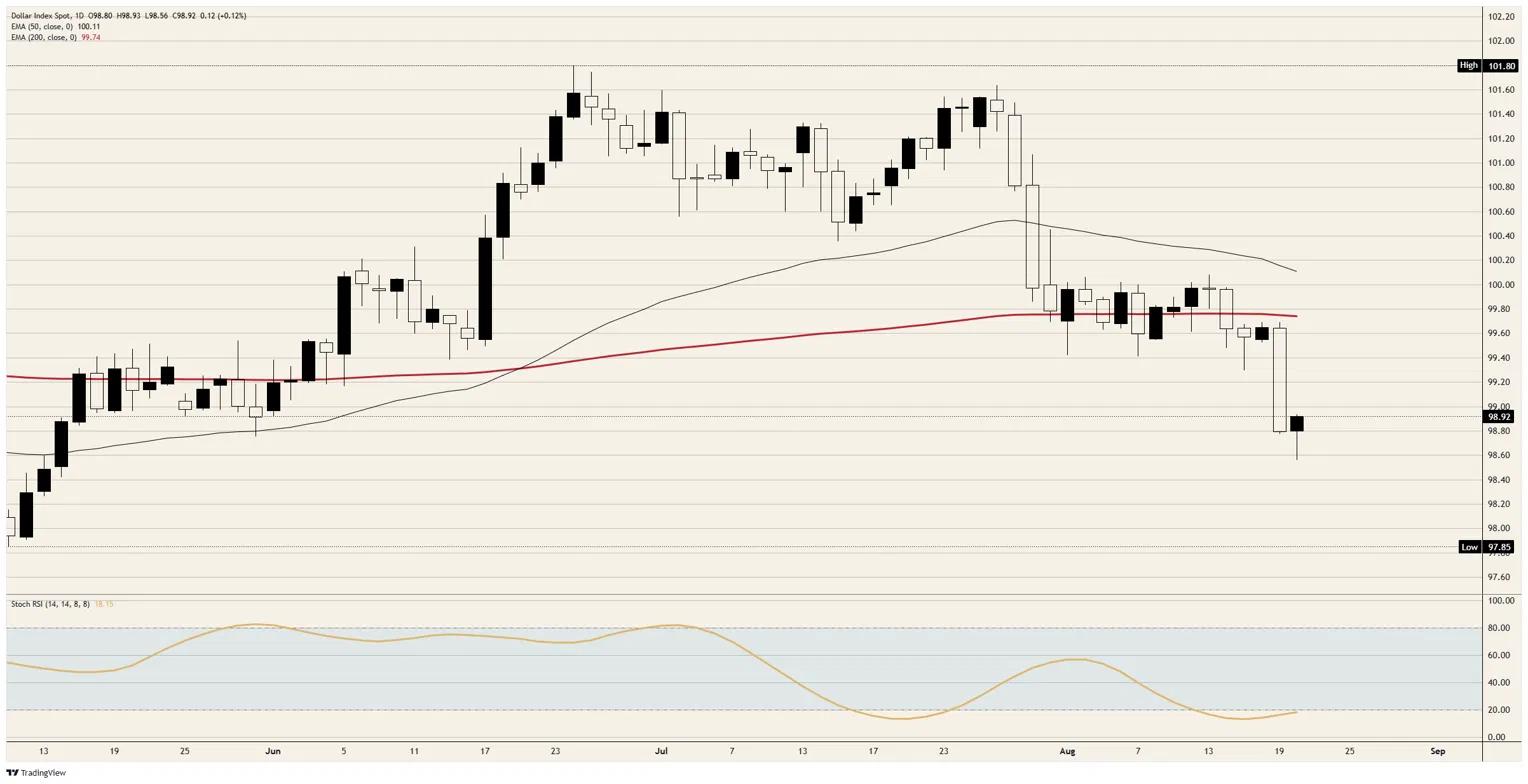
The Dollar Index has spent Thursday building a floor just above 98.50 and defending it with everything the calendar had to offer, and the entire effort is worth roughly a tenth of a point. A five-year high in Philadelphia manufacturing, a jobless claims beat and a hawkish regional Fed voice have between them lifted the index 0.12% off a base last visited in the middle of May. The floor is real enough. What built it will not hold it.
The best data the Dollar could have asked for
The session low just above 98.50 printed in the London morning, hours before a single release, and the recovery off it was already underway when the 12:30 GMT block landed. Initial jobless claims came in at 206K against a 210K consensus and 212K the week before. The Philadelphia Fed’s August manufacturing survey read 47.4 against a consensus of 25 and a 41.4 prior, which is less a beat than a different question being answered.
Underneath that headline the survey reads stronger still, with an employment index up 18 points to its highest since April 2022 in a summer when the national payroll count printed an outright contraction, and a six-month outlook index up 39 points to a level last seen in 1983. The Dollar Index still trades more than a point beneath its 50-day Exponential Moving Average (EMA) and roughly eight tenths of a point beneath the 200-day, with the 50-day rolling over toward it.
Two Fed voices and no vote between them
The 12:30 GMT appearance scored neutral against its own speaker average and read softer than that in substance. The message was that the bond market is signalling policy sits in a good place, that the Fed’s credibility is not at risk, and that it is too early to judge how the Treasury’s debt-management decisions bear on the central bank’s work. The index eased back toward 98.75 through that interview window.
The 15:10 GMT appearance scored hawkish and scored exactly at its own speaker average, which is the tell. It came from a policymaker who favoured a quarter point in July, who still thinks inflation is more likely than not to stay above target and who argues that moving now spares a larger move later, then declined to commit to anything for September. The leg that carried the index to its session high just short of 99.00 began inside the quarter hour after those remarks, and neither speaker holds a vote on the Federal Open Market Committee (FOMC) this year.
The easing nobody on the committee voted for
What broke the Dollar this week did not come from the Fed at all. The Treasury said on Wednesday it would at least double its liquidity-support buybacks in the 10-year to 30-year sector, raising the ceiling to 4 billion Dollars per operation from 2 billion, effective September 9 through November 4. Long-end yields had run to their highest since 2006 in the days before that announcement. The index fell roughly eight tenths of a point on it, the sharpest single-session decline in three weeks.
A fiscal authority capping the long end delivers duration relief that no FOMC member voted on and that never shows up as a cut, and a currency prices that the way it prices a cut. Issuance shifts toward bills, the long end gets repurchased, and none of it touches the Fed’s balance sheet. Futures pricing now has September hike odds beneath a third, down from an even split on August 10. A hawkish non-voter on television does not compete with that.
Friday’s flash surveys, then Wyoming
Friday August 21 at 13:45 GMT brings the preliminary August S&P Global surveys, all three carrying red-band billing. The manufacturing consensus sits at 53.8 against a 53.9 prior and services at 54 against 54.6, with the composite last at 54.5. Consensus is looking for a flat-to-softer month from a national Purchasing Managers Index (PMI) panel, one day after a regional survey printed its best current-activity reading in five years.
The larger date is August 27-29 in Jackson Hole, where the chair delivers a first symposium keynote. Nothing between now and then forces the front end to reprice, which leaves Friday’s surveys setting the tone for a week rather than the direction for the quarter. A firm PMI print argues this floor holds into the symposium. A soft one hands the sellers the 98.50 area.
Dollar Index levels
Resistance: The 99.00 handle caps the session and has not been reclaimed since Wednesday’s break. Above it, the 200-day EMA near 99.75 is the first line that matters, with the declining 50-day just above 100.00 behind it.
Support: The 98.50 area is the base this session built, and the last structure beneath it is the May low just short of 98.00. Daily Stochastic Relative Strength Index (Stoch RSI) near 18 has the index oversold without turning, which reads as basing rather than as a low.
Bias: Bearish while 99.00 caps. Objectives are the 98.50 area and then the 98.00 handle, with invalidation on a daily close above 99.75.
DXY daily chart
US Dollar FAQs
The US Dollar (USD) is the official currency of the United States of America, and the ‘de facto’ currency of a significant number of other countries where it is found in circulation alongside local notes. It is the most heavily traded currency in the world, accounting for over 88% of all global foreign exchange turnover, or an average of $6.6 trillion in transactions per day, according to data from 2022.
Following the second world war, the USD took over from the British Pound as the world’s reserve currency. For most of its history, the US Dollar was backed by Gold, until the Bretton Woods Agreement in 1971 when the Gold Standard went away.
The most important single factor impacting on the value of the US Dollar is monetary policy, which is shaped by the Federal Reserve (Fed). The Fed has two mandates: to achieve price stability (control inflation) and foster full employment. Its primary tool to achieve these two goals is by adjusting interest rates.
When prices are rising too quickly and inflation is above the Fed’s 2% target, the Fed will raise rates, which helps the USD value. When inflation falls below 2% or the Unemployment Rate is too high, the Fed may lower interest rates, which weighs on the Greenback.
In extreme situations, the Federal Reserve can also print more Dollars and enact quantitative easing (QE). QE is the process by which the Fed substantially increases the flow of credit in a stuck financial system.
It is a non-standard policy measure used when credit has dried up because banks will not lend to each other (out of the fear of counterparty default). It is a last resort when simply lowering interest rates is unlikely to achieve the necessary result. It was the Fed’s weapon of choice to combat the credit crunch that occurred during the Great Financial Crisis in 2008. It involves the Fed printing more Dollars and using them to buy US government bonds predominantly from financial institutions. QE usually leads to a weaker US Dollar.
Quantitative tightening (QT) is the reverse process whereby the Federal Reserve stops buying bonds from financial institutions and does not reinvest the principal from the bonds it holds maturing in new purchases. It is usually positive for the US Dollar.