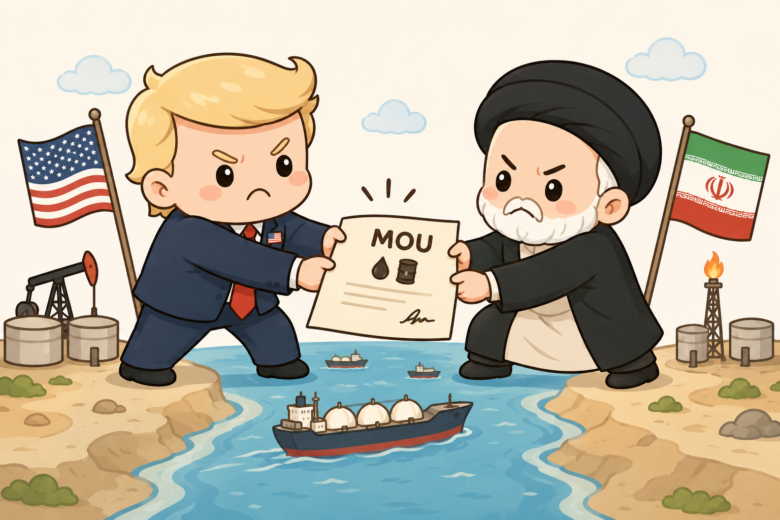
A weekend of tit-for-tat strikes between the U.S. and Iran blew a hole in the month-old ceasefire deal, putting WTI crude, gold, and the dollar back on edge heading into a jobs-heavy week.
What Actually Happened?
Let’s back up a few days to set the stage for what went down between the U.S. and Iran over the weekend.
On Thursday, June 26, an Iranian drone hit the Ever Lovely, a Singapore-flagged container ship navigating the Strait of Hormuz along a U.S.-supported route near Oman. After that, the U.S. military struck Iranian missile and radar sites along the coast on Friday.
On Saturday, Iran’s forces hit the Kiku, a Panama-flagged tanker carrying over two million barrels of crude oil. U.S. Central Command responded by striking 10 Iranian military targets, including air defense and drone storage sites. Iran fired back Sunday morning with ballistic missiles and drones at U.S. military bases in Kuwait and Bahrain.
That’s four exchanges in four days. By Sunday afternoon, Iran had skipped technical ceasefire talks scheduled in Doha and threatened to halt negotiations.
All of this sits inside a 60-day MOU that the US and Iran signed on June 14. The agreement said Iran would work toward safe passage through Hormuz, but Iran says the U.S. violated it first by supporting a shipping route it hadn’t approved. The U.S. says Iran shot first. Both are correct, depending on which lane you’re watching.
Promoted: When Geopolitical Headlines Hit, Execution Matters
The weekend’s US-Iran strikes can show how quickly the market can sort winners from wishful thinkers. For traders, that kind of rotation is where preparation matters. Lux Trading Firm offers access to real capital, with funding programs built for disciplined traders who can spot opportunity without chasing every shiny headline.
Learn More at Lux Trading Firm Disclosure: To help support our free daily content, we may earn a commission from our partners if you sign up through our links, at no extra cost to you.
How Did This Happen?
The Strait of Hormuz between Iran and Oman, transits roughly 20% of the world’s oil and 20% of global liquefied natural gas trade, according to the US Energy Information Administration.
Iran closed this waterway in late February after U.S. and Israeli strikes on Iranian territory. When the June 14 MOU landed, traders priced in a reopening fast. WTI crude fell nearly 4% in a single session on June 26, dropping to a four-month low of around $69 a barrel, as Saudi Arabia’s Ras Tanura export terminal resumed crude loading for the first time in nearly four months.
Ras Tanura’s return was a big deal because it meant Persian Gulf supply was coming back. Then the weekend strikes arrived, and WTI climbed back toward $70 by Monday morning.
 The core dispute isn’t exactly military but more about routing. Iran insists vessels use lanes it designates, closer to its coastline, and has charged transit tolls. The U.S. says those conditions aren’t in the MOU. Iranian Foreign Minister Araghchi said Sunday that any attempt to establish “separate arrangements” from Iran’s designated corridor “will only lead to further complications.” That gap is what produced four days of fire.
The Ras Tanura news adds one more layer. The terminal resumed crude loading on Friday, June 26. On Sunday morning at 6 a.m. local time, a Saudi Aramco helicopter crashed there, killing all 14 workers on board. Saudi authorities launched an investigation and found no link to the military exchange.
Still, a major Gulf export hub appearing twice in the same weekend’s headlines, once for a supply recovery and once for a fatal crash, is not noise traders can set aside.
What Does This Mean for Markets?
Oil is still likely the first mover. WTI had been pricing in a clean reopening, but it hadn’t priced in the scenario where Iran and the U.S. keep shooting at each other despite a ceasefire.
The conflict history is worth knowing. Oil surged more than 50% at the peak of the fighting earlier this year, then it fell back more than 36% from those highs when the MOU was signed. Traders front-ran the reopening, but the weekend showed that front run went too far.
Gold pulls in two directions. The war premium on gold had been fading, as fresh escalation tends to pull safe-haven demand back in. But the dollar is the stronger force right now, and a firmer dollar presses gold regardless of headlines. If Iran escalation pushes the dollar up, gold faces two headwinds at once. If talks resume and the dollar softens, gold has room toward $4,135.
The dollar and the Iran situation aren’t on separate tracks. Thursday’s Non-Farm Payrolls is the week’s primary driver, but an oil spike from Iran re-escalation keeps inflation alive. In turn, inflation jitters keep Fed rate hike talk alive. Rate hike talk supports the dollar.
Quick Takeaways
- The US-Iran ceasefire is under serious strain after four rounds of strikes between Thursday and Sunday over competing interpretations of safe passage through the Strait of Hormuz.
- WTI crude climbed back toward $70 on Monday after falling to near $69 on Friday. The $73 level is the marker to watch: a daily close above it signals war premium is rebuilding.
- Markets tend to spike on headlines, then reverse. The June conflict produced multiple intraday swings that fully reversed the same session. Daily closes matter more than first-candle reactions.
- Peace talks are paused, not dead. US and Iranian officials were still scheduled to meet in Doha this week. A ceasefire confirmation would flip the oil trade fast.
The U.S.-Iran exchange is a live example of how geopolitical shocks move oil, gold, and currencies in ways that go beyond what charts alone can explain. Premium members can read our lesson:
📖 Geopolitical Risk, Trade Policy, and Safe Haven Flows
Reading this helps you understand how geopolitical events drive currency moves, which safe havens attract flows during escalation, and why the dollar and gold can pull in opposite directions when risk spikes.
And if you’re not a Premium subscriber yet, now’s a good time to sign up.
With Babypips Premium, you get full access to School of Pipsology lessons that help you understand not just what oil, gold, and dollar pairs are doing, but the geopolitical forces and safe haven dynamics driving them.