
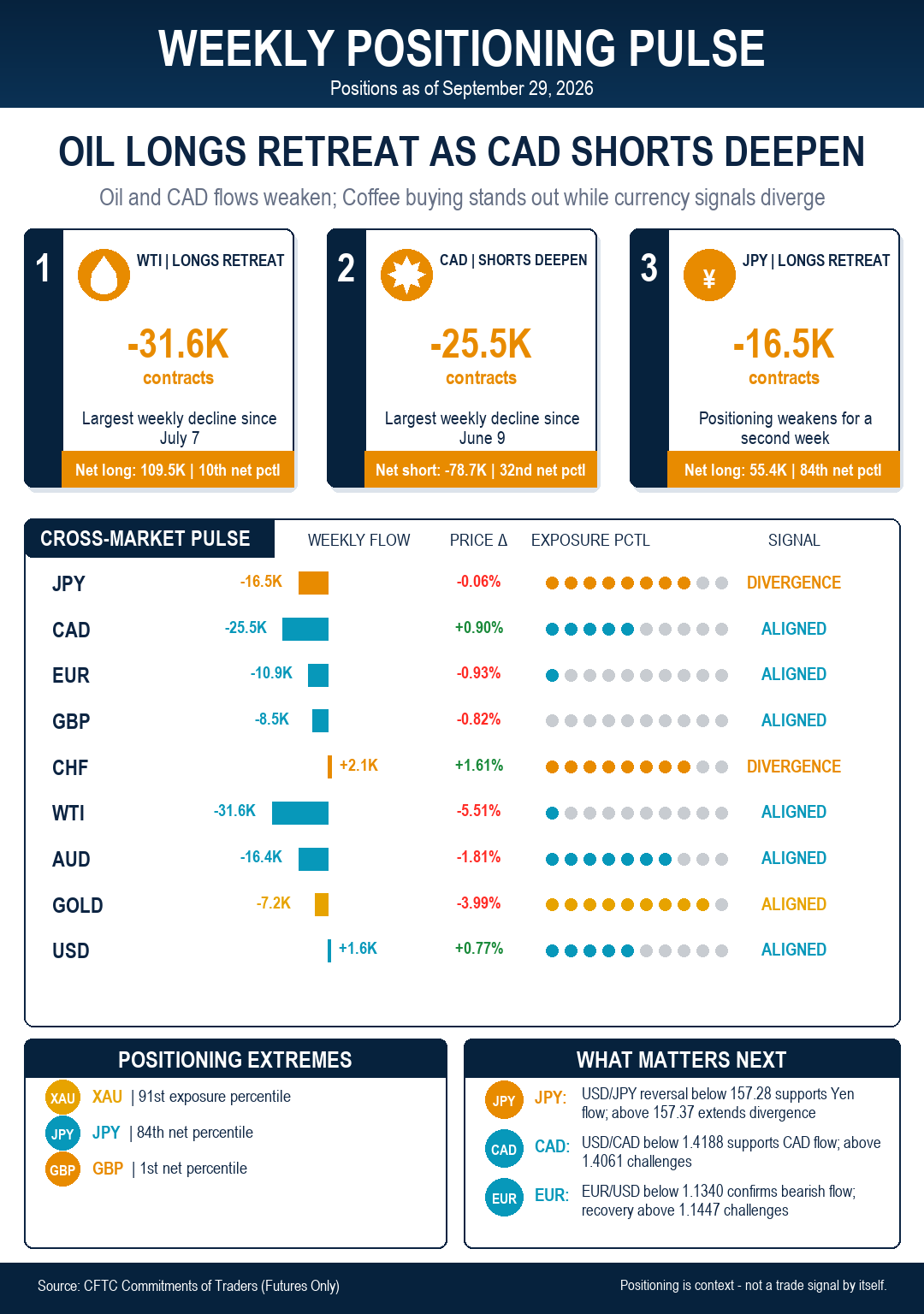
The week in one sentence: During the week leading up to September 29, long positions in crude oil were significantly reduced, while short positions in the Canadian Dollar went up. In addition, the positioning of the Australian Dollar and the Japanese Yen declined, while Coffee buying stood out against a more general background of defensiveness. Despite the fact that Gold prices continued to fall, the exposure to the precious metal remained high.
WTI longs in an extended retreat
The net long exposure that speculators had on the WTI decreased to around 109.5K contracts. The price went down by more than 5%, approaching the $89.00 mark per barrel, which indicates that the market is going to confirm the positioning signal. Exposure is close to the 11th percentile, while net positioning is close to the 10th percentile. If the trend were to get more confirmation from price, it would be strengthened; a reversal would indicate that the flow is starting to decrease.
Canadian Dollar shorts deepen
Non-commercial traders turned less constructive on the Canadian Dollar (CAD), increasing their net longs to nearly 78.7K contracts. According to the market, the positioning signal is being confirmed as spot climbed markedly to the vicinity of the 1.4200 hurdle. Further data showed the net positioning close to the 32nd percentile, while the speculative exposure is close to the 51st percentile. The trend would be strengthened by more price confirmation, while a reversal would raise the argument that the flow is beginning to diminish.
Price and positioning are still at odds
The Japanese Yen (JPY) showed the most obvious inconsistencies. Due to the fact that the price and the flow of speculation are moving in different directions, the signal is not yet complete enough to be considered a clear trend call. When it comes to traders, the following move is more important than the snapshot. A continuation would verify the flow, but a reversal would reveal the mismatch.
Where the flow has confirmation
At the same time, the price and positioning of CAD, EUR, WTI, GBP and Gold moved in the same direction. This provides the manoeuvre with a more solid tactical footing; nevertheless, it is still necessary to follow through with it the following week; a speedy reversal would transform the seeming confirmation into a misleading impression.
The crowded trade
The most crowded exposure is XAU, which is located at the 91st percentile, while the opposite extreme, which is close to the 1st percentile, is GBP. The practical point is that asymmetric risk is problematic: crowded exposure is susceptible to a sudden unwind, while the position with the least amount of exposure has more capacity to rebuild in the event that the market reverses.
Positioning Map
Gold is the clearest crowded long by exposure at the 91st percentile, meaning its net position is large relative to open interest. JPY has the strongest outright net-positioning reading at the 84th percentile, while GBP sits near the 1st net percentile and is therefore unusually lightly owned. These measures capture different dimensions: exposure highlights crowding, whereas the net percentile shows how large or small the position is in absolute historical terms. The map therefore flags crowded exposure in Gold and the greatest potential room for rebuilding in GBP, without treating either extreme as a standalone reversal signal.