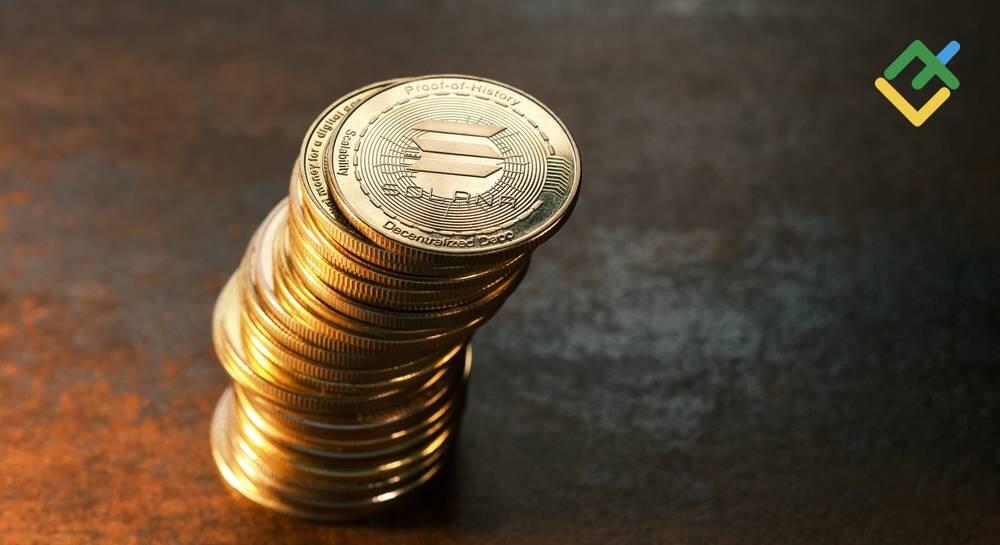
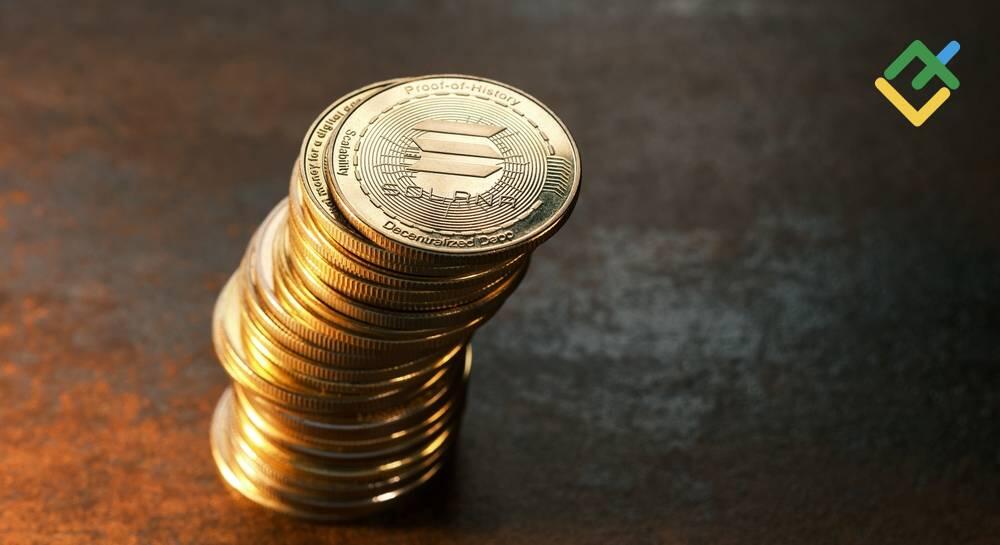

Solana is a high-performance blockchain platform whose architecture combines Proof of History for transaction ordering with Tower BFT consensus built on Proof of Stake. Together, these innovations enable transaction throughput comparable to Visa at minimal cost. Although the network has weathered several major outages, reliability concerns remain, and competition from Ethereum, Sui, and Aptos continues to intensify.
The long-term SOL price outlook depends above all on the network’s ability to scale without sacrificing security. Sustained growth requires real adoption across DeFi, gaming, and payments, as network utility will ultimately matter far more than speculative demand.
The article covers the following subjects:
Major Takeaways
-
Based on the real-time SOLUSD chart, the Solana price is trading at $118.76 as of 28.09.2026. Over the past 24 hours, the price has changed by -2.81%.
-
Solana reached its all-time high of $295.45 on 19.01.2025, which represents a change of 59.81% from the current price.
-
The lowest price of SOL was recorded on 11.05.2020 and stood at $0.51, representing a change of 23,406.81% from the current price.
-
SOLUSD’s all-time high and low differ by 58,382.48%.
-
The current market sentiment for Solana indicates that 63.01% of traders favor the following position: Buy.
-
Solana’s price analysis suggests that the asset will trade between $84.32 and $167.18 throughout 2026.
-
According to the long-term forecast, the price of Solana may reach $139.62 in 5 years, $139.62 in 10 years, and $128.26 by 2050.
SOL Real-Time Market Overview
|
Metric |
Value |
|
Market Capitalization |
$69.36B |
|
24-Hour Trading Volume |
$3.82B |
|
Volume/Market Cap Ratio |
+5.50% |
|
All-Time High |
$295.45 |
|
1-Year Change |
-43.65% |
|
Circulating Supply |
587.78M SOL |
Metrics explained:
-
Market capitalization is the total value of all SOL coins in circulation, reflecting the asset’s scale and overall market influence.
-
24-hour trading volume is the total value of all SOL transactions across all exchanges over the past 24 hours.
-
The Volume/Market Cap ratio measures the 24-hour trading volume relative to the market capitalization.
-
The all-time high is the highest price SOL has ever reached since its launch.
-
The 1-year change is the percentage change in SOL’s price over the past 365 days.
-
Circulating supply is the number of SOL coins currently available on the market, excluding locked tokens such as team vesting allocations and reserved funds.
Solana Price Forecast and Analysis for Today 28.09.2026
Technical analysis is a method of analyzing and forecasting price movements in financial markets based on historical data, charts, and various indicators.
Indicators help identify trend direction, support and resistance levels, and entry and exit points. The analysis uses different time frames (M30 and H4), allowing for both short-term and medium-term perspectives on the asset. As a result, traders receive specific daily recommendations, including take-profit and stop-loss levels.
The daily SOLUSD chart shows that the price is trading within a channel between $117.62 and $122.68.
Current trend according to ADX: upward, strong (50).
A general recommendation based on moving averages and the Bollinger Bands, Ichimoku, Stochastic, MACD, Williams %R, and ZigZag indicators for intraday trading on the M30 time frame: buy; on the H4 time frame: buy.
Recommendation based on RSI readings: wait.
The Bollinger Bands, EMA21, and EMA50 are used to generate today’s short-term trading signals:
-
Signal — sell.
-
Support level — $95.82.
-
Resistance level — $124.95.
-
Recommended entry point — $110.39.
-
Take Profit — $95.82.
-
Stop Loss — $126.41.
Weekly Solana Price Forecast and Technical Analysis as of 28.09.2026
Let’s analyze the weekly SOLUSD chart using key indicators on the D1 time frame and Ichimoku Cloud signals on the W1 time frame to identify potential entry points and optimal stop-loss levels.
On the weekly chart, the price is trading between $102.69 and $140.35.
A general recommendation based on MA10, MA20, MA50, and MA100 moving averages, as well as the BBands, Ichimoku, Stochastic, MACD, Williams %R, and ZigZag indicators on the D1 time frame: sell.
Dominant trend for the coming week based on the Ichimoku signal on the W1 time frame: upward.
Trades can be opened at $92.54.
The price is expected to reach $60.13 over the coming week. Thus, a take-profit order can be placed at this level.
To limit potential losses in an adverse scenario, a stop-loss order can be placed at $128.19.
Solana Price Forecast for 2026 Based on Technical Analysis
Based on Solana’s historical price performance, the asset could reach a low of $84.32 in 2026, while the projected high is around $167.18. The average SOL price is expected to be around $120.09, corresponding to a change of +1.12% from the previous year’s closing price.
Below is Solana’s (SOL) price forecast for 2026:
| Date | Minimum, $ | Average Price, $ | Maximum, $ |
|---|---|---|---|
| 15.10.2026 | 84.32 | 120.11 | 167.18 |
| 15.11.2026 | 114.44 | 127.86 | 141.29 |
| 15.12.2026 | 110.31 | 124.29 | 138.28 |
What Other Analysts Predict for Solana in 2026
Experts have differing views on Solana’s performance through the end of 2026. Some forecast high volatility, with periods of decline followed by a recovery, while others expect stronger growth in the second half of the year. However, most forecasts suggest that SOL will strengthen by year-end after possible short-term corrections.
LongForecast
According to LongForecast, Solana is expected to experience high volatility toward the end of 2026. In September, the price may decline from $101.53 to $93.78, with the downward trend continuing in October to $90.84 despite a wide trading range of $79.83–$124.19. A recovery to $105.37 is expected in November. In December, the price will likely remain relatively stable and end the year at around $104.63.
Coin Price Forecast
According to Coin Price Forecast, Solana is expected to show mixed performance in 2026. The price is projected to decline to $74.98 by mid-year before potentially recovering in the second half of the year. By the end of December, SOL may reach $114.49. However, the forecast price would still be approximately 8% below its level of $124.79 at the beginning of the year.
CoinCodex
According to CoinCodex, Solana is expected to show a predominantly upward trend through the end of 2026. The average price is projected to reach $107.53 in September before rising sharply to $134.79 in October. A slight correction to $133.08 is expected in November. Growth may resume in December, with the average price reaching $136.34 and a high of $141.41.
How We Forecast Solana Prices
Our Solana price forecast is based on advanced technical analysis supported by our hierarchical Bayesian model, kernel-based machine learning techniques, and hyperparameter optimization.
This modern analytical model is designed to forecast SOL and other asset price movements. It processes market data and identifies patterns based on shared characteristics. The model then analyzes underlying factors that may influence price movements, including market sentiment and broader trends.
The Bayesian model accounts for complex and nonlinear market relationships rather than relying on simple market patterns. It incorporates historical data, filters out market noise, and provides a range of potential outcomes instead of a single fixed forecast. In addition, the analysis is supported by expert opinions to provide a broader long-term view of the asset.
This comprehensive approach allows us to conduct a thorough analysis of Solana prices and make reliable forecasts. However, although Bayesian methods are at the forefront of modern neural network research, no model can guarantee accurate results. After all, it is impossible to predict fundamental factors and sudden market shifts.
Solana Price Forecast for 2027 Based on Technical Analysis
Historical Solana price trends suggest the asset may decline to a low of $88.20 and climb to a high of $139.62 in 2027. The average SOL price is forecast to stand at $111.98, reflecting a change of -6.75% from the closing price of 2026.
Below is the forecast for the Solana (SOL) price in 2027:
| Date | Minimum, $ | Average Price, $ | Maximum, $ |
|---|---|---|---|
| 15.01.2027 | 109.70 | 124.66 | 139.62 |
| 15.02.2027 | 99.80 | 114.39 | 128.97 |
| 15.03.2027 | 93.69 | 108.31 | 122.93 |
| 15.04.2027 | 91.36 | 106.54 | 121.72 |
| 15.05.2027 | 92.96 | 109.36 | 125.77 |
| 15.06.2027 | 88.20 | 104.69 | 121.18 |
| 15.07.2027 | 89.09 | 106.70 | 124.30 |
| 15.08.2027 | 89.75 | 108.45 | 127.16 |
| 15.09.2027 | 93.76 | 114.34 | 134.92 |
| 15.10.2027 | 95.50 | 116.46 | 137.43 |
| 15.11.2027 | 95.52 | 116.49 | 137.46 |
| 15.12.2027 | 92.95 | 113.35 | 133.76 |
Solana Price Forecast for 2028 Based on Technical Analysis
The analysis of historical Solana price data indicates that the asset will reach a low of $78.73 and a high of $134.67 in 2028. The average price is expected to be around $103.39, representing a change of -7.67% from the closing price of 2027.
Below are the Solana (SOL) price projections for 2028:
| Date | Minimum, $ | Average Price, $ | Maximum, $ |
|---|---|---|---|
| 15.01.2028 | 93.58 | 114.12 | 134.67 |
| 15.02.2028 | 85.49 | 104.25 | 123.02 |
| 15.03.2028 | 80.82 | 98.56 | 116.30 |
| 15.04.2028 | 79.67 | 97.16 | 114.64 |
| 15.05.2028 | 82.27 | 100.33 | 118.39 |
| 15.06.2028 | 78.73 | 96.01 | 113.29 |
| 15.07.2028 | 80.64 | 98.34 | 116.04 |
| 15.08.2028 | 82.34 | 100.42 | 118.49 |
| 15.09.2028 | 87.42 | 106.61 | 125.80 |
| 15.10.2028 | 89.41 | 109.03 | 128.66 |
| 15.11.2028 | 89.66 | 109.35 | 129.03 |
| 15.12.2028 | 87.32 | 106.48 | 125.65 |
Solana Price Forecast for 2029 Based on Technical Analysis
Given past fluctuations in the SOL price, the coin may plunge to a low of $74.29 and climb to a high of $126.88 in 2029. The average price is estimated to reach $98.04, indicating a change of -5.17% from the closing price of 2028.
The table below shows the price forecast for the Solana (SOL) price in 2029:
| Date | Minimum, $ | Average Price, $ | Maximum, $ |
|---|---|---|---|
| 15.01.2029 | 88.17 | 107.52 | 126.88 |
| 15.02.2029 | 80.28 | 97.91 | 115.53 |
| 15.03.2029 | 75.81 | 92.46 | 109.10 |
| 15.04.2029 | 74.86 | 91.30 | 107.73 |
| 15.05.2029 | 77.66 | 94.70 | 111.75 |
| 15.06.2029 | 74.29 | 90.60 | 106.91 |
| 15.07.2029 | 76.38 | 93.15 | 109.92 |
| 15.08.2029 | 78.25 | 95.43 | 112.61 |
| 15.09.2029 | 83.49 | 101.82 | 120.15 |
| 15.10.2029 | 85.64 | 104.44 | 123.23 |
| 15.11.2029 | 86.05 | 104.94 | 123.83 |
| 15.12.2029 | 83.85 | 102.25 | 120.66 |
Solana Price Forecast for 2030 Based on Technical Analysis
Previous Solana price data suggest that the asset will reach a low of $71.60 and a high of $122.09 in 2030. The average price is predicted to be around $94.80, which is equivalent to a change of -3.31% from the closing price of 2029.
Here are the projected Solana (SOL) price targets for 2030:
| Date | Minimum, $ | Average Price, $ | Maximum, $ |
|---|---|---|---|
| 15.01.2030 | 84.84 | 103.46 | 122.09 |
| 15.02.2030 | 77.09 | 94.01 | 110.94 |
| 15.03.2030 | 72.75 | 88.72 | 104.70 |
| 15.04.2030 | 71.93 | 87.72 | 103.51 |
| 15.05.2030 | 74.84 | 91.27 | 107.70 |
| 15.06.2030 | 71.60 | 87.31 | 103.03 |
| 15.07.2030 | 73.80 | 90.00 | 106.20 |
| 15.08.2030 | 75.78 | 92.42 | 109.05 |
| 15.09.2030 | 81.13 | 98.94 | 116.75 |
| 15.10.2030 | 83.37 | 101.68 | 119.98 |
| 15.11.2030 | 83.89 | 102.30 | 120.71 |
| 15.12.2030 | 81.78 | 99.73 | 117.68 |
Long-Term Solana Price Forecast Through 2050
Predicting Solana’s price through 2050 remains highly challenging, as the market is influenced by many unpredictable factors, including technological developments, regulatory changes, macroeconomic conditions, and investor sentiment. For this reason, long-term forecasts should be viewed as general market scenarios rather than precise projections and should not be used as the sole basis for investment decisions.
According to our stochastic jump-diffusion model, Solana may trade between $75.76 and $128.26 by 2050. The lower range reflects potential market stagnation or tighter regulation, while the higher range assumes broader crypto adoption and continued blockchain development. These projections incorporate a confidence interval to account for the substantial uncertainty associated with long-term market forecasts.
| Year | Minimum, $ | Average Price, $ | Maximum, $ |
|---|---|---|---|
| 2033 | 68.83 | 91.48 | 117.76 |
| 2034 | 68.75 | 91.42 | 117.81 |
| 2035 | 68.86 | 91.60 | 118.10 |
| 2036 | 69.12 | 91.93 | 118.55 |
| 2037 | 69.46 | 92.37 | 119.10 |
| 2038 | 69.86 | 92.87 | 119.71 |
| 2039 | 70.30 | 93.41 | 120.36 |
| 2040 | 70.76 | 93.98 | 121.04 |
| 2041 | 71.24 | 94.56 | 121.74 |
| 2042 | 71.73 | 95.16 | 122.45 |
| 2043 | 72.22 | 95.77 | 123.17 |
| 2044 | 72.72 | 96.38 | 123.89 |
| 2045 | 73.23 | 96.99 | 124.61 |
| 2046 | 73.73 | 97.61 | 125.34 |
| 2047 | 74.24 | 98.22 | 126.07 |
| 2048 | 74.74 | 98.84 | 126.80 |
| 2049 | 75.25 | 99.46 | 127.53 |
| 2050 | 75.76 | 100.08 | 128.26 |
Sentiment in News and Social Media Activity
Media buzz and social sentiment serve as key indicators for gauging public interest in Solana and the prevailing mood surrounding it. Media buzz refers to the total volume of mentions and discussions, while social sentiment reflects the prevailing tone: bullish, bearish, or neutral.
Increased media buzz combined with positive social sentiment may signal a potential price surge, while growing panic can indicate a possible decline. However, these signals should be considered alongside other analytical methods rather than used in isolation.
Latest News and Sentiment on Social Media
We use FinBERT, a pre-trained neural network developed for financial text analysis, to assess the overall news landscape. The model analyzes content from more than 50 sources, including MarketWatch, CNBC, and Bloomberg. In addition, FinBERT monitors posts on X, Telegram, Discord, and Reddit to evaluate media sentiment.
Overall sentiment across news and social media for SOLUSD: Neutral.
Media buzz for Solana today: Medium.
Solana Fear and Greed Index
The Fear and Greed Index reflects the overall emotional state of the cryptocurrency market. It shows whether fear or greed is currently dominating market behavior and is expressed on a scale from 0 to 100, where 0 indicates extreme fear (panic, selling) and 100 indicates extreme greed (euphoria, buying). The index is calculated using factors such as volatility, trading volume, social media activity, Google Trends, and other data. Updated daily, the Fear and Greed Index serves as a market thermometer, helping gauge overall investor sentiment.
The current value of the Solana Fear and Greed Index: 74 (greed).
The index helps identify periods of excessive fear or greed in the market. You can buy when fear prevails and sell when greed takes over.
Solana Price History
Solana (SOL) reached its all-time high of $295.45 on 19.01.2025. The lowest price of Solana (SOL) was recorded on 11.05.2020 when the coin declined to $0.51.
Below is the SOLUSD chart. It is crucial to analyze historical data to improve forecast accuracy.
-
March 2020. Solana launched at around $0.22.
-
February 2021. Riding the crypto bull run, SOL surged to $15, drawing significant investor attention.
-
September 2021. Fueled by the alt season and the growth of the NFT and DeFi ecosystem, the price soared to $180, pushing SOL into the top 10 cryptocurrencies.
-
November 2021. Solana reached an all-time high of $260, driven by the NFT boom and the expansion of decentralized applications.
-
January 2022. A market-wide correction pulled the price down to $90.
-
November 2022. The FTX collapse sent the price crashing to $8.
-
2023–2024. The price recovered to $200, supported by the resurgence of the Solana ecosystem.
-
January 2025. New all-time high of $295.
-
September 2026. After falling to around $65 in June, Solana recovered. By mid-September, SOL was trading at around $97, gaining nearly 29% over the previous month.
Solana Fundamental Analysis
Solana is a high-performance blockchain whose price reflects both speculative demand and genuine technological value. Fundamental analysis helps determine whether the asset is currently undervalued or overvalued from a long-term perspective.
What Factors Affect the SOL Price?
-
Network performance. Improvements in speed, scalability, or stability directly boost investor confidence, while outages and downtime have an immediate negative impact on price.
-
Ecosystem health and DeFi activity. SOL’s price is closely tied to the volume of capital locked in decentralized applications. The growth of projects such as Jupiter, Raydium, and Marinade Finance expands the token’s utility, while a higher number of active addresses and transactions signals stronger demand for SOL.
-
Institutional adoption. The inclusion of Solana in the portfolios of major funds, the launch of an ETF, or partnerships with traditional financial institutions serve as powerful catalysts for growth. Institutional interest adds legitimacy to the asset and attracts significant capital.
-
Macro conditions and crypto market trends. Like most altcoins, SOL closely follows Bitcoin and global liquidity trends. Fed rate hikes tend to weigh on risk assets like SOL, while looser monetary policy and a weaker dollar have historically acted as tailwinds for crypto.
-
Tokenomics and supply unlocks. Scheduled token issuance and unlocks from venture capital rounds create selling pressure.
-
Regulatory clarity. Favorable regulation in key jurisdictions broadens access to exchanges and wallets, improving liquidity and expanding the investor base.
-
Competitive pressure. Solana is frequently benchmarked against Ethereum, Avalanche, Sui, and Aptos. A significant technological breakthrough by a competitor could trigger a temporary price decline, making continued dominance in the high-performance blockchain niche a key condition for long-term growth.
More Facts About SOL
Solana is a high-performance layer-1 blockchain designed to support decentralized applications and cryptocurrencies at a global scale.
Solana’s key technological edge lies in its Proof of History (PoH), a cryptographic timekeeping system in which validators generate their own cryptographic timeline rather than relying on timestamps from other nodes. This significantly increases the network’s throughput.
Tests show that Solana can theoretically process more than 50,000 transactions per second, and up to 65,000 under certain conditions, with an average fee of less than a cent. This is achieved through Sealevel, its parallel transaction execution runtime, which also eliminates the need for sharding.
SOL, the network’s native token, is used to pay transaction fees and for staking. The larger a validator’s stake, the greater their influence on consensus. The Solana ecosystem spans thousands of projects, from decentralized exchanges and lending protocols to NFT marketplaces and blockchain games.
Advantages and Disadvantages of Investing in Solana
Solana attracts investors with its speed and low transaction fees. However, its volatility and centralization risks call for a cautious approach when investing.
Advantages
-
High throughput. Solana can process up to 65,000 transactions per second, surpassing most blockchain networks.
-
Low fees. Transaction costs typically remain below $0.01, making Solana well-suited for micropayments and gaming applications.
-
Proof of History technology. This proprietary innovation provides a verifiable sequence of timestamps, enabling high transaction speeds without compromising security.
-
Thriving DeFi ecosystem. Decentralized exchanges, lending protocols such as Solend, and liquid staking platforms like Marinade attract billions of dollars in liquidity.
-
Growing NFT sector. Marketplaces such as Magic Eden and Tensor consistently rank among the leaders in NFT trading volume.
-
Strong institutional backing. Investments from companies such as Multicoin Capital and Jump Crypto continue to support the development of Solana’s infrastructure.
-
Real-world integration. Projects focused on payments, logistics, and GameFi are expanding the network’s practical use cases.
-
Active development. The Solana team regularly introduces upgrades aimed at improving network performance and stability.
-
Wide accessibility. SOL is available on all major cryptocurrency exchanges and can be purchased without complex verification procedures on many platforms.
Disadvantages
-
Network outages. Solana experienced several major outages in 2022–2023 due to software bugs and periods of exceptionally high network activity.
-
Centralization concerns. The small number of validators and the high hardware requirements create a risk of conspiracy.
-
High volatility. SOL has lost more than 80% of its value from its previous all-time highs, highlighting the risks associated with short-term trading.
-
Ecosystem security risks. The 2022 Wormhole bridge exploit resulted in losses of $320 million and raised concerns about the security of infrastructure connected to the Solana ecosystem.
-
Development complexity. Using Rust requires a high level of expertise, which limits the number of applications compared to Ethereum.
-
Dependence on major market participants. FTX and Alameda’s past dominance exacerbated market manipulation involving the token.
-
Growing competition. Rapid progress among Ethereum Layer 2 networks and other high-performance Layer 1 blockchains may reduce Solana’s share of developer activity and liquidity over time.
Conclusion: Is Solana a Good Investment?
Solana is one of the most technically mature blockchains, capable of processing thousands of transactions per second with minimal fees. Its ecosystem is actively expanding, attracting developers of DeFi, NFT, and gaming projects. However, its investment appeal comes with significant risks, including high volatility, periodic network outages, and dependence on the overall state of the crypto market. Competition from Ethereum, Avalanche, and other platforms is also putting pressure on the project.
Solana may be a worthwhile addition to a diversified portfolio for long-term investors who have a high risk tolerance and believe in the future growth of blockchain technology. However, it should not be viewed as a core holding due to its elevated risk profile. Before investing, it is important to assess the network’s technical updates, ecosystem development, and broader market conditions.
SOLUSD Price Prediction FAQs
Price chart of SOLUSD in real time mode
The content of this article reflects the author’s opinion and does not necessarily reflect the official position of LiteFinance broker. The material published on this page is provided for informational purposes only and should not be considered as the provision of investment advice for the purposes of Directive 2014/65/EU.
According to copyright law, this article is considered intellectual property, which includes a prohibition on copying and distributing it without consent.