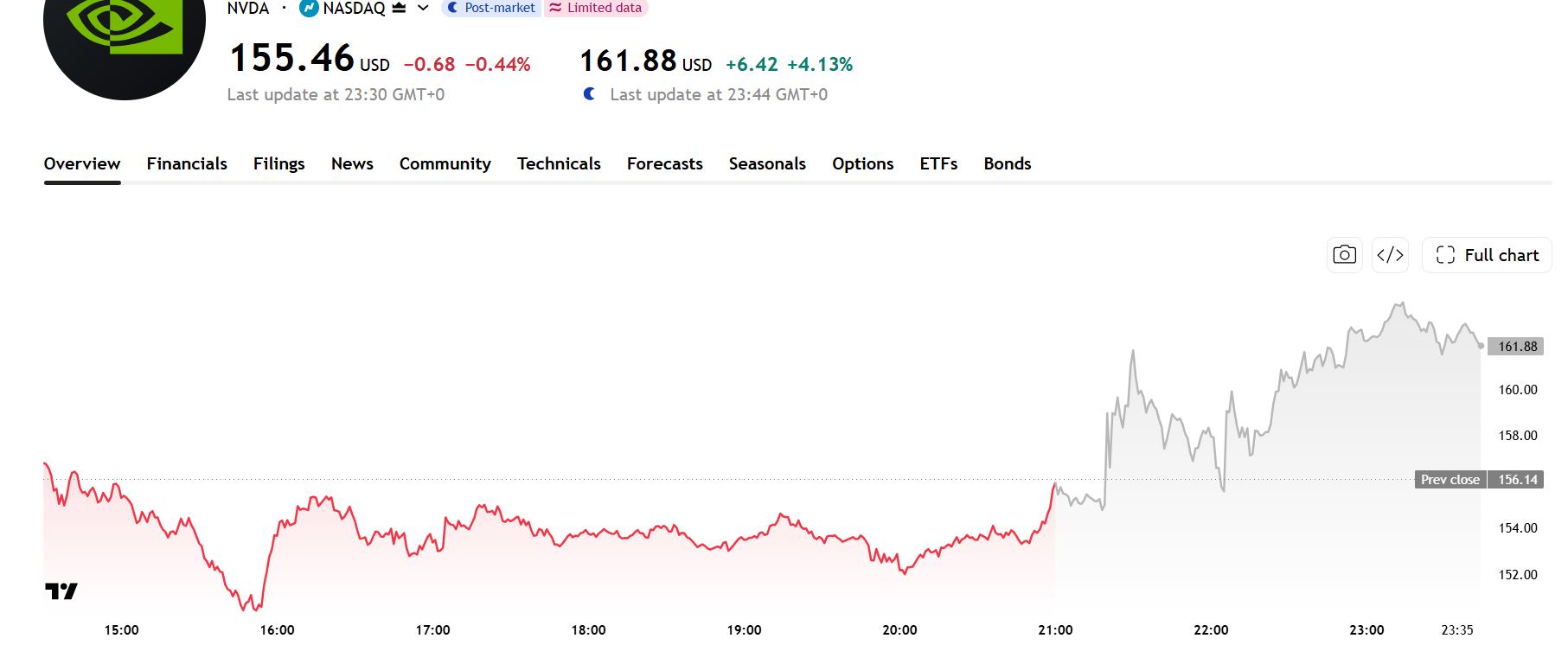
Nvidia’s results have landed without a hitch. The stock price is rising by more than 4% in post-market trading, and investors are giving a warm welcome to the first set of Nvidia earnings without Jensen Huang at the helm.
These earnings were similar, yet different, from what we have come to expect from Nvidia. The numbers were definitely familiar. Nvidia delivered another monster earnings report. Revenues for last quarter smashed estimates, coming in at $115.8bn, vs. $109.33bn expected.
Revenue forecasts unscathed by Huang drama
However, it was the forecast for this quarter’s revenue that blew past analyst expectations and helped to boost the share price. New interim CEO Colette Kress said that Q4 revenue growth would be $127.4bn to $132.6bn, beating expectations of $125.25bn.
Nvidia to remain innovative powerhouse
The company said that the ramp up of its latest and most advanced chip, the Vera Rubin, is its fastest yet. It also added that it expected to deliver new generations of compute on an annual basis. This could ease fears that the company will lose its innovative edge without its founder at the helm.
While massive financial figures have become the norm for Nvidia, there were key differences in this earnings report. Firstly, interim CEO Colette Kress and the new chair of the board, Harvey Jones, set out at the start of the call that the board would not be reinsinstating Jensen Huang as CEO. This cemented comments from last week, where Jones and other board members clearly stated Huang was no longer involved in the business.
Huang’s power move falls flat
Ahead of today’s earnings call, Jensen Huang released a statement saying that he would be happy to step back into the role of CEO, after a number of his former colleagues, investors and even the President called for his return. This was a provocative move, mere hours before the earnings call. However, the chair of the board was assertive in his dismissal of this idea.
While Jensen Huang has been integral to Nvidia’s success, this earnings call was designed to impress on investors, the public and the media, that Nvidia is not reliant on one individual, and has a strong future in a post-Huang era.
Is Huang a Shakesperean hero or villain?
Developments at Nvidia in the past week are Shakespearean in their levels of drama, with Jensen Huang roaming the wilds of Silicon Valley like a modern day King Lear. You can almost hear him hiss ‘How sharper than a serpent’s tooth/ to have a thankless child.’
It will be worth watching to see if the Board’s public rebuff of his offer to return as CEO, in favour of an external candidate, will keep Huang quiet. He has a lot on his plate, including testifying to Congress in early December.
Business as usual
The key message from this earnings report is that it is business as usual under Nvidia’s new regime. These numbers suggest continuity at the business and financial level, with sensational levels of demand. Nvidia is basically a cash-generating machine. The company reported free cash flow of $43.8bn for last quarter. This money is being deployed into the AI ecosystem, and today’s report said that the company has provided a total of $118bn of guarantees, including for the build out of more data centres.
Nvidia continues to support wider AI ecosystem
This is an important number, it suggests that even without Jensen Huang, the company is still willing to be part of the financing operation for the AI ecosystem, although Kress stated this only starts at the compute stage of development and not at the picks and shovels stage. This may ease concerns about how the AI sector would fare without Jensen Huang, and in after hours trading it is worth noting that CoreWeave, a neocloud business that is heavily reliant on Nvidia, is higher by nearly 10%.
China developments of note
China was always going to be the elephant in the room on this earnings call, and there were three developments linked to this. The first is that the results indicated how much revenue came from China last quarter, $2.4bn. The second is that the company has stopped shipping their less advanced Hopper chips to China, with little explanation as to why. Thirdly, Kress said that even with new export controls that were put in place on Monday, this will not hit demand and the company can meet its 75% growth outlook for next year.
What next for the stock price
Nvidia’s stock price is rising sharply in after hours trading. However, after a $2 trillion valuation rout, if the stock price has bottomed out there is still a long recovery to go. To Kress’s credit, the earnings call was well managed and did what it needed to do: for the short term, at least, momentum remains strong, and AI demand is robust.
All eyes will be on whether the stock price can extend these gains on Wednesday, and if Kress’s clarity on revenue forecasts, sales to China and how it funds the AI ecosystem is enough to rebuild confidence in the AI trade.
Chart 1: Nvidia daily price chart with post-market trading