Consumer confidence surveys track how Americans feel about the economy, and those feelings move markets.
The Conference Board’s Consumer Confidence Index for June 2026 came in at 91.2, missing the 94.0 forecast and landing below levels many analysts considered the floor.
Days earlier, the University of Michigan’s Consumer Sentiment Index clocked its second-lowest reading on record at 49.5 for the month, recovering from May’s all-time low of 44.8 but still sitting 19% below where it stood a year ago.
Here’s how the two main surveys work, why they’re leading indicators, and what June 2026’s results say about the road ahead.
What Actually Is a Consumer Confidence Survey?
Think of it as a pulse check on the mood of ordinary Americans. Every month, economists survey hundreds or thousands of households and ask them questions such as:
- How do you feel about your finances right now?
- Do you expect things to get better or worse?
- Is now a good time to find a job?
- Are you planning to make a big purchase soon?
The answers get crunched into a single index number.
Higher number, more optimism. Lower number, more pessimism.
But two separate organizations run these surveys, and they each take a slightly different angle:
The Conference Board Consumer Confidence Index (CCI), released on the last Tuesday of each month, focuses heavily on labor market conditions. It asks consumers how they view current business conditions and job availability, plus their expectations for six months out. The Conference Board surveys approximately 3,000 U.S. households monthly.
The University of Michigan Consumer Sentiment Index (MCSI), released mid-month and then revised at month-end, leans harder into household finances and inflation perceptions. It also captures year-ahead and five-year inflation expectations, which the Federal Reserve watches closely. Around 500 households get surveyed each month by phone.
Have a solid trading strategy but lack the capital? FundedNext empowers disciplined traders by providing simulated trading accounts up to $200K.
Unlike other prop firms, FundedNext imposes no artificial time limits on challenges. You even earn a unique 15% profit share during your evaluation! Once funded, you keep up to a 95% profit split with guaranteed 24-hour payouts. Trade CFDs or Futures your way—even during major news events.
Join over 400K traders who have received $300M+ in payouts. Ready to back your edge?
Learn More About FundedNext! Limited time offer: Use code BPFN for discounts on both CFD & Futures plans! T&C apply. T&C apply.Disclosure: We may earn a commission from our partners if you sign up through our links, at no extra cost to you.
Why Are These Surveys Considered Leading Indicators?
A leading indicator (an economic term for data that signals where the economy is heading before it gets there) is valuable precisely because it gives you advance notice.
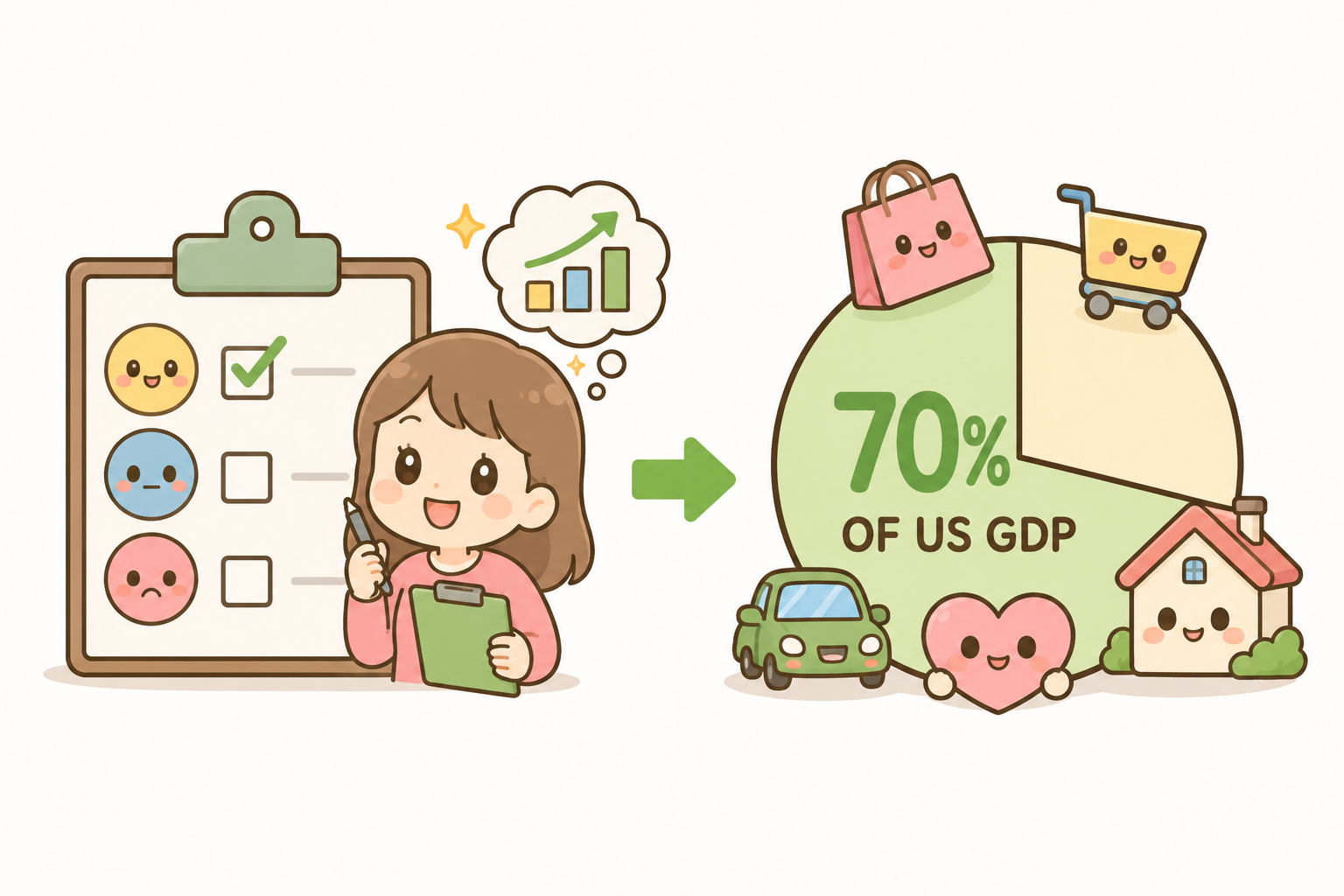 Unemployment figures tell you what already happened to the job market. Consumer confidence surveys tell you what consumers plan to do next, and consumer spending drives roughly 70% of US gross domestic product.
When consumers feel confident, they spend more. Businesses see stronger demand, hire more workers, and invest in growth. GDP rises.
When consumers feel anxious, they pull back. Spending slumps. Companies slow hiring or cut jobs. GDP slows.
This is why economists, central banks, and forex traders treat these surveys as forward-looking signals rather than backward-looking scorecards.
For forex traders, a stronger-than-expected consumer confidence reading often pushes the U.S. dollar (USD) higher, because it implies stronger economic growth and potentially a more hawkish Federal Reserve. A miss tends to weigh on the dollar, as it points toward softer growth and more pressure on the Fed to ease.
Neither outcome is guaranteed since multiple factors shape currency moves on any given day, but the surprise relative to consensus is frequently a catalyst for USD movement.
What Do the Latest Surveys Say About the US Economy?
June 2026’s results paint a complicated picture. Not a collapse. Not a recovery. Something messier.
Conference Board Index
The CCI rose a modest 0.6 points to 91.2, but only because May’s figure was revised sharply lower to 90.6 from an initial reading of 93.1. Relative to the 94.0 forecast, June still missed.
According to the Conference Board’s press release, consumers’ views of their current family financial situation deteriorated for a third straight month, with roughly equal shares describing conditions as “good” versus “bad.”
The share of respondents saying a US recession over the next 12 months is “somewhat likely” ticked up, though most still call recession unlikely. Consumers’ write-in comments skewed pessimistic, with prices and gas costs among the most frequently cited worries, though references to Middle East conflict eased slightly.
University of Michigan Index
The MCSI final reading landed at 49.5, up roughly 10% from May’s record low of 44.8. The recovery appears tied to moderating gasoline prices after Strait of Hormuz tensions pushed fuel costs higher earlier in the year.
Long-run business expectations jumped 16%, suggesting consumers’ worst fears about the Iran conflict’s lasting economic damage may be fading. Still, sentiment remains 13% below February 2026 levels (before the conflict began) and nearly 20% below a year ago.
Year-ahead inflation expectations edged down to 4.6% from 4.8% in May — an improvement, but still well above the 3.4% reading from February and all 2024 readings. Five-year inflation expectations fell to 3.3%, down from 3.9% in May.
Two takeaways stand out:
- Consumers appear to be bouncing off a floor, not recovering toward past confidence levels.
- Inflation anxiety remains the dominant theme.
The Conference Board noted that references to prices in write-in responses stayed elevated even as geopolitical mentions fell. More than half of Michigan survey participants spontaneously mentioned high prices as the primary drag on their personal finances for the third straight month.
The Conference Board projects US GDP growth at 1.8% for 2026, down from 2.1% in 2025. Business investment in AI and technology is seen as keeping the economy afloat while consumer spending softens. That’s a productive economy carrying a nervous consumer.
How Does This Affect the Market?
Consumer confidence surveys feed into the broader USD narrative in a few key ways.
- Fed policy signals: Persistently low consumer sentiment, especially paired with elevated inflation expectations, gives the Federal Reserve a complicated puzzle. High inflation expectations argue for keeping rates elevated; weak confidence suggests the economy may not withstand it. The Fed watches Michigan’s inflation expectations figures closely.
- USD reaction to surprises: June’s Conference Board miss (91.2 vs. 94.0 expected) likely weighed on the dollar in Tuesday’s session, though the move was limited given stronger JOLTS job openings data arriving at the same time.
- Risk sentiment and currency pairs: A deteriorating consumer confidence trend tends to strengthen safe-haven currencies like the Japanese yen (JPY) and Swiss franc (CHF) relative to risk-sensitive currencies tied to US growth expectations. Pairs like AUD/USD and CAD/USD can also feel the drag when US consumer data disappoints.
- Cross-asset ripple effects: Equity markets process confidence data too. S&P 500 performance often reflects consumer spending expectations, and equity-currency correlations mean forex traders benefit from tracking both.
Promoted: Is Your Small Account Holding Your Strategy Back?
Trading $100 isn’t the same as trading $100k. Emotional discipline & trading flexibility is easier when you have the right backing. FTMO is a global prop firm with a 4.8★ rating on 40K+ reviews, serving traders since 2015! No time limits. Free trials. Up to $200K in Demo Capital.
Start a free trial with FTMO!
Disclosure: To help support our content, we may earn a commission from our partners if you sign up through our links, at no extra cost to you.
The Bottom Line
Consumer confidence surveys from the Conference Board and University of Michigan measure how Americans feel about the economy — both right now and six to twelve months ahead.
Because consumer spending accounts for roughly 70% of US GDP, these surveys function as leading indicators: they point toward where growth is headed before the official GDP data confirms it.
June 2026’s results show a fragile, partial recovery from historically depressed levels. The Conference Board CCI came in at 91.2, missing the 94.0 forecast. The University of Michigan Sentiment Index finished at 49.5, up from May’s record low but still 19% below a year ago.
Elevated inflation expectations — 4.6% for the year ahead per Michigan, down from 4.8% in May — remain the dominant drag on consumer mood, complicating the Fed’s path and creating uncertainty for USD direction.
Traders may want to watch the relationship between consumer confidence trends and actual spending data. If spending holds up despite low sentiment, the dollar’s reaction to future misses may be more muted.
If you’re not sure why consumer confidence surveys move currency markets or how they fit into the broader data landscape, Premium members can read our lesson:
📖 Key Economic Indicators: The Data That Moves Currencies
Reading this helps you understand which economic releases actually move markets, the difference between leading and lagging indicators, and how to prioritize data like consumer confidence surveys in your pre-trade analysis.
And if you’re not a Premium subscriber yet, now’s a good time to sign up.
With Babypips Premium, you get full access to School of Pipsology lessons that help you understand not just what the numbers say, but which data releases actually matter, why surprises move currencies, and how to build a data-driven trading process around the economic calendar.