Markets snapped a defensive streak on Wednesday after the U.S. Treasury said it would at least double the size of its long-end bond buyback operations, a surprise move that pulled Treasury yields down, sent the dollar to a three-month low, and lit a broad rally across equities, gold, and bitcoin. The greenback finished as the worst-performing major on the day, while the July FOMC minutes showed several officials had favored a rate hike last month.
Check out the forex news and economic updates you may have missed in the latest trading session!
News Headlines & Data:
Broad Market Price Action:
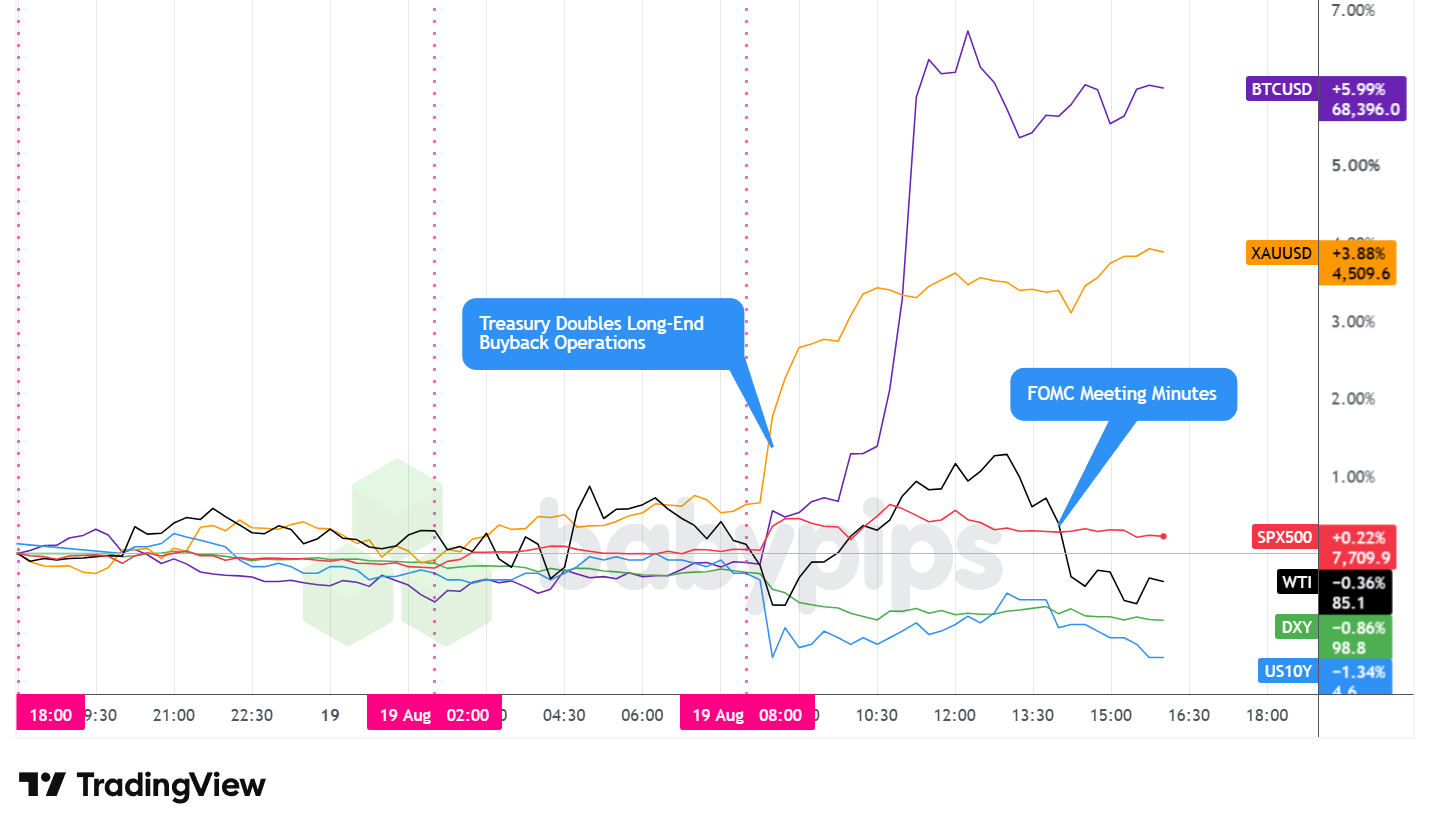
Dollar Index, Gold, Oil, S&P 500, U.S. 10-yr Yield, Bitcoin Overlay – Chart Faster With TradingView
Wednesday split into two clear halves. Through the Asian and London hours, most assets held tight ranges as traders waited on the Middle East and priced elevated long-end yields. Then the U.S. Treasury announced a doubling of its long-end buyback operations around mid-morning in New York, and the session broke wide open. Yields dropped, the dollar sank, and gold, bitcoin, and stocks pushed higher into the afternoon. The July FOMC minutes landed at 2:00 p.m. ET and showed a committee still split on whether more tightening was needed, though the reaction was muted against the buyback news.
The S&P 500 traded near 7,690 through the overnight hours before firming into the London morning and then jumping after the U.S. open, spiking to a session high near 7,744 by late morning. It faded through the afternoon toward 7,709, closing up around 0.22% on the day. Chipmakers stayed under pressure and capped the advance, though the broader index still snapped its recent losing run as falling yields eased the pressure on risk appetite.
Oil chopped through a wide range without a clear trend. WTI traded near $85.50 in Asia on a fourth straight session of Gulf-driven gains, dipped toward $84.30 after the U.S. open, then rallied to a high near $86.73 by early afternoon before sliding back to settle around $85.10, roughly flat to slightly lower on the day. The Strait of Hormuz standoff stayed live, with the UAE halting all trade with Iran and France moving to expel two Iranian diplomats, keeping a floor under prices even as the dollar collapse pulled focus elsewhere.
Treasury yields fell hard on the buyback news. The U.S. 10-year traded near 4.69% through the overnight session before dropping sharply after the U.S. open, sliding to a low near 4.64% and closing near 4.66%, down roughly 1.34% on the day. The Treasury said it would at least double the size of its liquidity-support buybacks for 10-to-30-year securities, from $2 billion to at least $4 billion per operation, a mid-quarter change that markets read as a signal Washington wanted to cap borrowing costs after 30-year yields hit a 19-year high the prior session.
Gold reversed Tuesday’s slide and ripped higher. The metal traded near $4,350 through Asia and London before exploding after the U.S. open, surging past $4,470 within an hour and grinding to a close near $4,510, up around 3.88% on the day. Falling real yields and the sinking dollar did most of the lifting, with the buyback-driven easing of financial conditions handing bullion the kind of backdrop it had lacked a day earlier.
Bitcoin was the standout mover, riding both the macro liquidity impulse and a crypto-specific tailwind. It held near $64,100 through the overnight hours before rocketing after the U.S. open, spiking to a high near $69,700 by late morning before easing back to close near $68,400, up around 5.99% on the day and its highest level in roughly two months. Falling long-end yields cut the appeal of holding cash-like Treasuries and pushed money toward risk. The rally likely drew added weight from the White House, where President Trump hosted crypto executives and pressed Congress to pass digital asset market structure legislation, framing the Clarity Act as central to keeping the U.S. ahead in the sector.
FX Market Behavior: U.S. Dollar vs. Majors
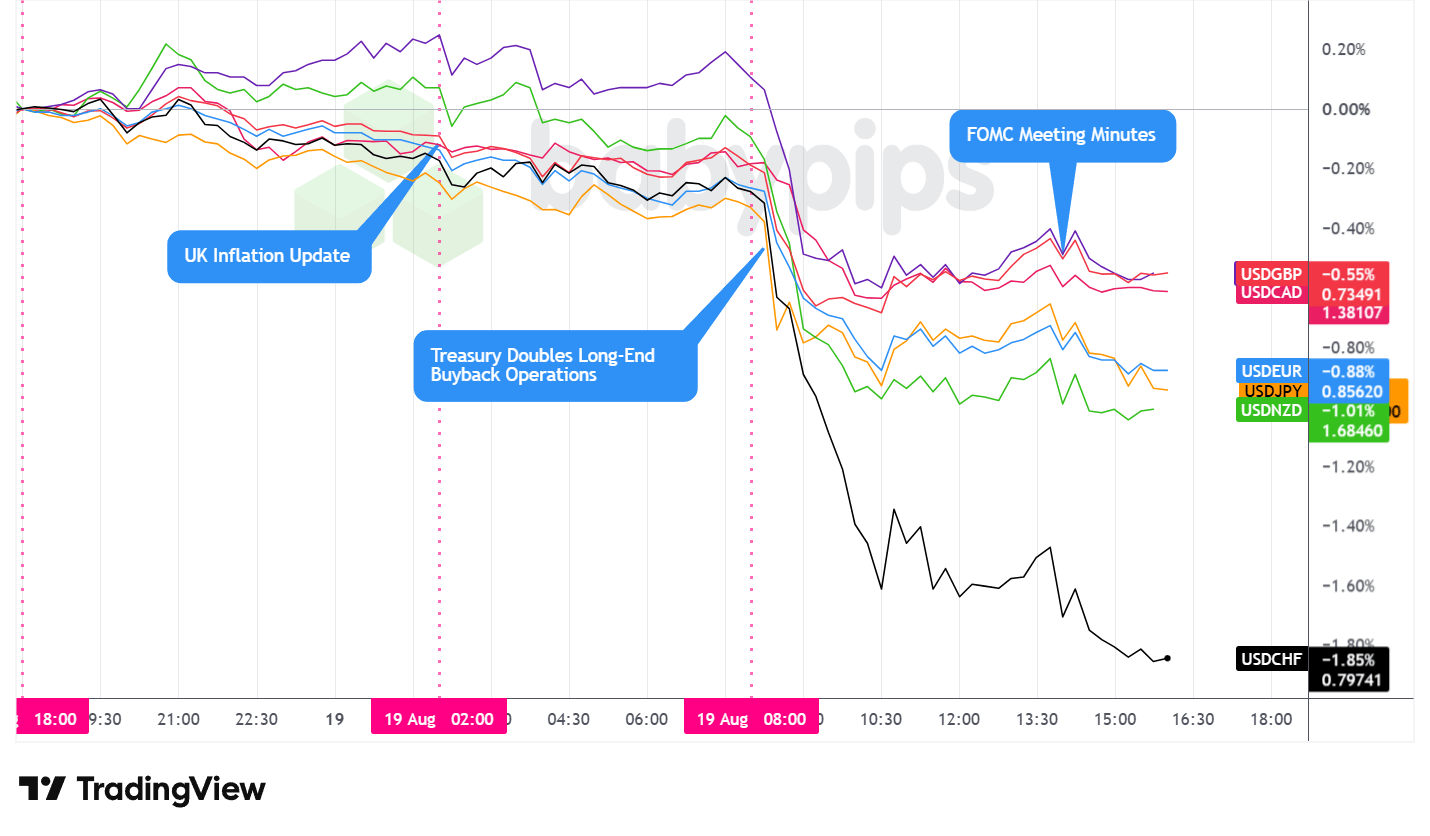
Overlay of USD vs. Major Currencies – Chart Faster With TradingView
The Dollar Index finished sharply lower, down roughly 0.86% near the 98.79 area, its weakest level in three months. The headline drop masked a session of two distinct halves, with a slow grind lower overnight giving way to a steep, catalyst-driven slide after the U.S. open.
From the Wednesday Asia open, the dollar traded slowly net lower against the majors. Treasury yields had eased overnight, taking some of the interest-rate support out from under the greenback, while a risk-off tone across Asian equities and a fourth straight session of Gulf-driven oil gains kept the backdrop unsettled. The move was gradual rather than sharp, with no single release forcing the pace.
Through the London session, the dollar stayed on the soft side and drifted lower still. U.K. inflation came in at 2.9% year-on-year for July, matching forecasts, and euro area final CPI confirmed 2.9%, neither print offering the dollar much of a counterweight. With long-end Treasury yields still leaking lower, the greenback leaned net negative into the U.S. open without a decisive break.
After the U.S. session opened, the dollar fell hard against every major on net, correlating with the Treasury’s announcement that it would at least double its long-end bond buyback operations. The news pulled Treasury yields sharply lower, and the drop in U.S. rates cut the dollar’s yield appeal and drove the index to its lows for the day. By around 10:30 a.m. ET the selling stabilized, and the dollar traded choppy for the rest of the session. At the close, the dollar was the worst-performing major on a daily basis, an outcome that fit a day defined by falling U.S. yields and a broad return of risk appetite rather than by any single rival currency’s strength.
Upcoming Potential Catalysts on the Economic Calendar
- Japan Balance of Trade for July 2026 at 11:50 pm GMT
- Australia Consumer Inflation Expectations for August 2026 at 1:00 am GMT
- Australia Employment Update for July 2026 at 1:30 am GMT
- Swiss Balance of Trade for July 2026 at 6:00 am GMT
- Germany PPI for July 2026 at 6:00 am GMT
- Euro area Labor Cost Index Flash for June 30, 2026 at 9:00 am GMT
- Germany Bundesbank Monthly Report at 10:00 am GMT
- U.K. CBI Industrial Trends Orders for August 2026 at 10:00 am GMT
- ECB Monetary Policy Meeting Accounts at 11:30 am GMT
- Canada Producer Prices Index for July 2026 at 12:30 pm GMT
- U.S. Initial Jobless Claims for August 15, 2026 at 12:30 pm GMT
- Philadelphia Fed Manufacturing Index for August 2026 at 12:30 pm GMT
- U.S. CB Leading Index for July 2026 at 2:00 pm GMT
Thursday’s session hinges on whether the Treasury’s buyback intervention keeps a lid on long-end yields or whether structural selling pressure reasserts itself, a question that will likely steer the dollar after its steep drop.
A busy calendar could add cross currents, with Australia’s July employment report and the ECB’s monetary policy meeting accounts offering fresh reads on two of the majors, while the U.S. initial jobless claims and the Philadelphia Fed manufacturing index give the clearest near-term signal on whether U.S. growth is cooling enough to keep the Fed sidelined.
The unresolved Hormuz situation and elevated oil prices remain a live risk under all of it.
Stay frosty out there, forex friends!
When the U.S. Treasury doubles its bond buyback operations and Treasury yields plummet, most traders see a falling dollar and falling rates as two separate stories. Premium members can read our lesson:
📖 How Bond Yields Affect Currency Movements
Reading this helps you understand why falling yields weaken the dollar, how yield differentials between countries drive currency trends, and why forex traders must monitor bond markets as closely as they watch price charts.
And if you’re not a Premium subscriber yet, now’s a good time to sign up.
With Babypips Premium, you get full access to School of Pipsology lessons that help you understand not just what the market is showing on your chart, but the bond market mechanics and yield dynamics driving every currency move