Australia shed 15,800 jobs in July, which at first glance looked like a clear sign that the labor market was cooling.
But the headline missed an important detail: full-time employment actually rose by 16,300, while part-time employment fell by 32,200 and the unemployment rate ticked up to 4.5%.
In other words, July looked more like a reshuffling of the job market than a broad-based slowdown. This distinction matters for both the Australian dollar and what the Reserve Bank of Australia (RBA) does next.
So What Did the Report Actually Say?
The Labour Force Survey put total seasonally adjusted employment at 14,807,200 in July. But the more interesting story was in the mix. Full-time employment rose 16,300 to 10,210,500, while part-time employment fell 32,200 to 4,596,700. The participation rate dipped to 66.9%, while the unemployment rate held at 4.5% in trend terms.
July’s miss stood out because June had set a much stronger backdrop. Australia added 80,200 jobs that month, revised up from 76,300, while the participation rate climbed to a one-year high of 67.0%. Traders were watching to see if that momentum would carry into July, but it didn’t.
Forecasts ranged from flat to a 15,000 gain, while most economists expected unemployment to hold at 4.4%. Instead, employment fell by 15,800, and the jobless rate ticked up to 4.5%.
One caveat: July’s survey used seven rotation groups instead of the usual eight because of the timing of new sample entrants. That smaller sample means wider standard errors, so the ABS recommends putting more weight on the trend data this month.
Promoted: Trading a Big Data Move With a Small Account?
Australia’s mixed jobs report showed how quickly currencies can swing when traders have to weigh the headline against the details. FTMO gives traders access to up to $200K in Demo Capital, with no time limits and free trials, so a solid macro view isn’t boxed in by a tiny account.
Disclosure: To help support our content, we may earn a commission from our partners if you sign up through our links, at no extra cost to you.
Why Does the Full-Time/Part-Time Split Matter?
Full-time jobs generally pay more and offer steadier income than part-time work, which matters for both spending and wage growth.
Part-time hours are often the first thing employers trim when they get cautious. Full-time layoffs usually come later.
July went the other way: part-time employment fell by 32,200, while full-time employment rose by 16,300. The underemployment rate, which tracks part-time workers who want more hours but can’t get them, also held at 6.4%. That suggests the labor market isn’t loosening as quickly as the headline decline implied.
For the RBA, that keeps the inflation story uncomfortable. More full-time workers means more wage income, which can support spending and keep price pressures sticky. The Fair Work Commission also raised Australia’s minimum wage by 4.75% from July 1, nearly double the midpoint of the RBA’s 2–3% inflation target.
With both full-time employment and the wage floor moving higher, the central bank still has little reason to ease.
What Does This Mean for the RBA and AUD?
Nine days before this report, the RBA held the cash rate at 4.35% and kept its hawkish bias intact. The board said it’s still prepared to raise rates if inflation risks flare up, while Governor Michele Bullock has said inflation isn’t expected to return to the midpoint of the 2–3% target band until early 2028.
Deputy Governor Andrew Hauser reinforced that message the day before the jobs release:
“If upside risks to inflation crystallize and we don’t see inflation coming down, we’ll have to raise interest rates again, and we’ll do so.”
The RBA still needs sustained, convincing disinflation before a rate cut becomes credible, and one mixed jobs report isn’t enough to change that. If anything, the rise in full-time employment supports the case for the August 11 hold.
AUD 5-minute Forex Chart Faster with TradingView
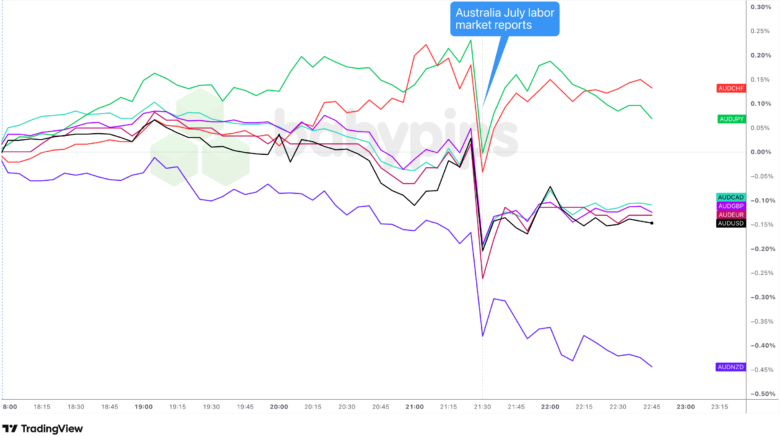
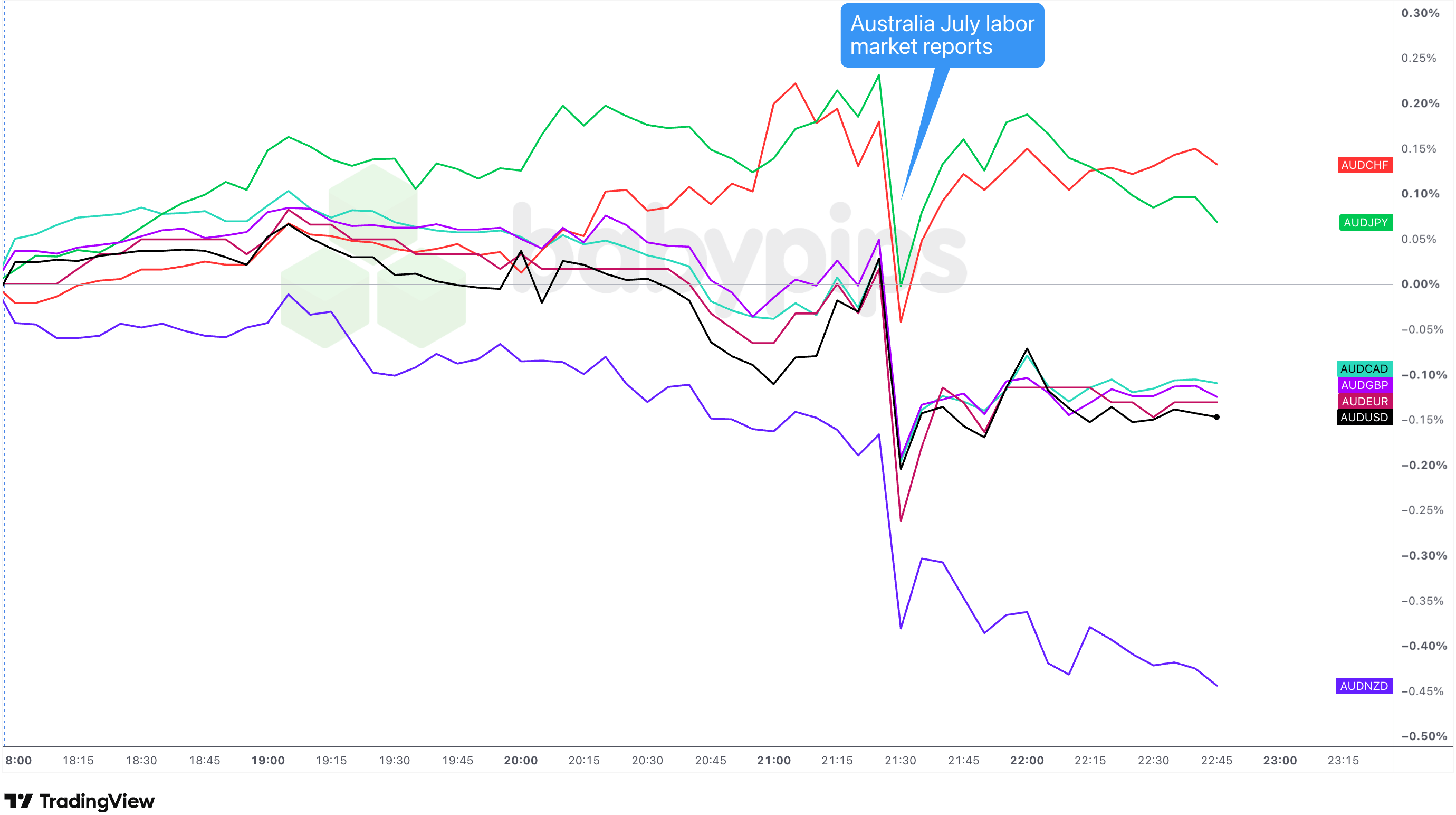
This is probably why the market reacted quickly. AUD/USD briefly spiked at the release before reversing and dropping about 0.20% within minutes. AUD/NZD moved even more, falling over 0.35% and drifting lower through the session. The initial pop was likely driven by the full-time gain, but selling probably took over once the weaker headline registered.
For newer traders, the logic is simple: a softer jobs report can reduce the odds of another RBA hike. Fewer expected hikes mean less reason to hold a higher-yielding currency like the Aussie, so a soft employment print can translate into a softer AUD.
That read can still change. If the next Labour Force Survey shows full-time employment falling alongside another drop in part-time work, the quality argument weakens quickly. A materially softer Wage Price Index would also give the RBA more room to soften its tone.
Neither signal is here yet, so the hawkish hold still looks intact. But one month doesn’t make a trend, and the August 26 CPI print will likely matter more for the September 29 decision than this jobs report alone.
The Bottom Line
Jobs reports have layers. The headline tells you the direction, but the composition tells you how strong or weak the move really is.
Australia lost 15,800 jobs in July, but full-time employment rose by 16,300 and the underemployment rate held steady. So the labor market didn’t loosen as much as the headline suggested.
For AUD/USD, that matters because the Aussie tends to find support when the RBA’s rate path stays elevated. Full-time job growth, a higher wage floor, and sticky inflation all help keep that backdrop in place. This report probably does more to support that view than undermine it, though the August 26 CPI print will be the bigger test for what comes next.
What to Watch Next
The August 26 monthly CPI report for July is the next big test for RBA rate expectations. The jobs report sets the backdrop, but inflation is more likely to move the needle.
The RBA meets again on September 29, while September’s Labour Force Survey should show whether July’s full-time strength holds or fades.
Governor Bullock’s speeches in the meantime are also worth watching for any shift in tone on employment or inflation.
If you’re not sure why AUD/USD initially spiked after Australia’s July jobs release before reversing sharply, you may not be familiar with how major economic data actually hits the FX market. Premium members can read our lesson:
📖 From Data to Price Action: What Happens When Big News Hits
Reading this helps you understand the two-stage price reaction to major data releases, why the initial algorithmic spike often reverses once analysis catches up, and how to read AUD charts around high-impact economic reports.
And if you’re not a Premium subscriber yet, now’s a good time to sign up.
With Babypips Premium, you get full access to School of Pipsology lessons that help you understand not just what the headline number says, but why the market moves the way it does the moment big data lands.