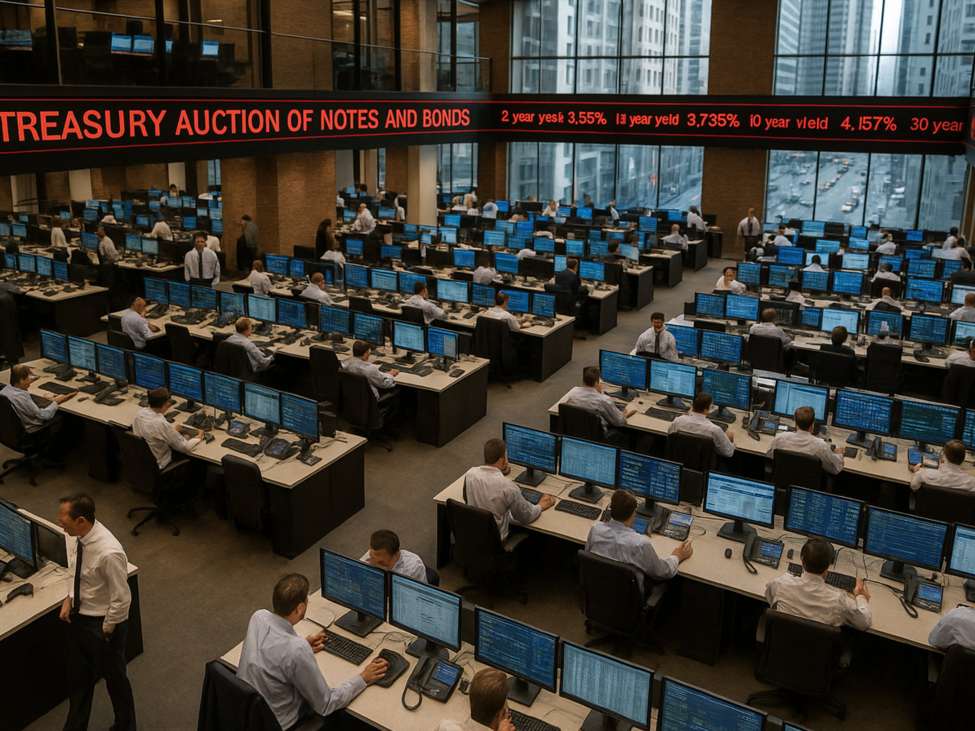
The US treasury has auctioned off $22Bof 30 year bonds at a high yield of 4.773%
The WI (when-issued) level at the time of the auction was 4.774%
The results of a US Treasury auction act as a real-time “report card” on the market’s appetite for US government debt. Because US Treasuries are the risk-free benchmark for the entire global financial system, the results ripple across all asset classes—stocks, currencies, and commodities.
Given the auction results, my AUCTION GRADE: B
Reasons for the B grade.
- The tails was -0.1 basis points lower than the WI level. Positive.
- The Bid to cover was on the screws vs the 6 month average. Average.
- Indrect bidders were higher than the 6 month average. Slight positive for international buyers
- DIrect bidders were near the 6 month average. Average
- Dealers were saddled with slightly less than average. Slight positive.
Yields are little changed after the completion of the coupon auctions.
US Treasury Auction Process: Key Components
The US Treasury auction process determines the yield (interest rate) the government pays on its debt. The market effectively “votes” on the price of US debt through this mechanism.
1. The “WI” Level (When-Issued) was 4.774%
-
Definition: “When-Issued” refers to trading that occurs in the time between the announcement of an auction and the actual auction itself.
-
Significance: It serves as the market’s “price consensus” or expected yield leading up to the deadline. It anchors the market’s expectations.
2. The Tail -0.1 basis point vs the 6 month average of 0.3 basis points
3. Bid-to-Cover Ratio 2.36X vs the 6 month average of 2.36X
4. The Bidders
The Treasury breaks down buyers into three categories to show who is buying the debt:
-
Indirect Bidders 65.4% vs the 6 month average of 63.7%
-
Who they are: Foreign central banks, international investors, and some domestic investment managers placing bids through a primary dealer.
-
Significance: Often viewed as a proxy for foreign demand. High indirect participation is generally seen as bullish (strong global confidence in US debt).
-
-
Direct Bidders 23.5% vs the 6 month average of 23.9%:
-
Who they are: Domestic money managers, insurance companies, hedge funds, and individuals placing bids directly with the Treasury (bypassing dealers).
-
Significance: Represents “real money” domestic demand.
-
-
Primary Dealers 11.2% vs the 6-month average of 12.5%
-
Who they are: Large banks (e.g., Goldman Sachs, JPMorgan) designated by the NY Fed. They are required to bid in every auction.
-
Significance: They act as the “backstop.” They buy whatever supply the Directs and Indirects don’t take. A high Dealer award is generally bearish (bad), as it means the banks are stuck holding excess inventory they must now try to sell into the secondary market.
-
Debt Statistics & This Week’s Auction Data
Total US Public Debt Outstanding:
As of early December 2025, the total public debt outstanding is approximately $38.4 trillion.
Treasury Auctions for the Week of December 8, 2025:
The Treasury issued the following amounts in the 3, 10, and 30-year maturities this week:
| Maturity | Auction Date | Amount Issued |
| 3-Year Note | Monday, Dec 8 | $58 Billion |
| 10-Year Note | Tuesday, Dec 9 | $39 Billion |
| 30-Year Bond | Thursday, Dec 11 | $22 Billion |
What to know about the US Treasury 30-Year Bond Auctions
The 30-year bond is the longest maturity debt instrument issued by the US government. It acts as a critical benchmark for long-term interest rates, influencing everything from mortgage rates to corporate bond pricing.
1. Frequency: When are they auctioned?
2. Auction Amounts: How much is sold?
-
Current Monthly Pace: As of late 2025, the Treasury typically auctions between $20 billion and $25 billion of 30-year bonds each month.
-
New Issues (Quarterly) are typically slightly larger (e.g., ~$25 billion).
-
Reopenings are typically slightly smaller (e.g., ~$22 billion).
-
-
Annual Total: This puts the total annual issuance of 30-year debt at approximately $280 billion to $300 billion per year.
3. How has the amount changed over time?
The size of 30-year bond auctions has increased significantly over the last decade to fund growing federal deficits.
-
2010s: For much of the post-2008 era, 30-year auction sizes were relatively small, often in the $10 billion to $15 billion range per month.
-
Pandemic Era (2020-2021): Auction sizes ramped up dramatically to fund stimulus measures, reaching peaks of roughly $24–27 billion per month.
-
Recent Trends (2024-2025): After a brief period of stabilization, auction sizes have begun creeping up again. The Treasury has had to increase coupon supply across the curve (2s, 5s, 10s, and 30s) to manage the higher interest expense and ongoing fiscal deficit.
4. Specifics for This Week (December 2025)
-
Auction Date: Thursday, December 11, 2025.
-
Type: This was a Reopening (of the bond originally issued in November).
-
Amount Auctioned: $22 Billion.
-
Result: The market closely watched this auction to see if investors demanded a higher yield (a “tail”) to absorb the supply, given the recent rise in rates.