So you’re staring at the charts, markets are tanking, and your palms are sweaty. Don’t worry—you’re not the only one wondering: “Where the heck do I put my money now?”
Welcome to the world of safe havens—those assets traders rush into when markets look scarier than a horror movie marathon. But here’s the catch: not all safe havens work in every situation. Sometimes the U.S. dollar is king, other times gold flexes its shiny muscles, and occasionally, even Bitcoin gets its five minutes of fame.
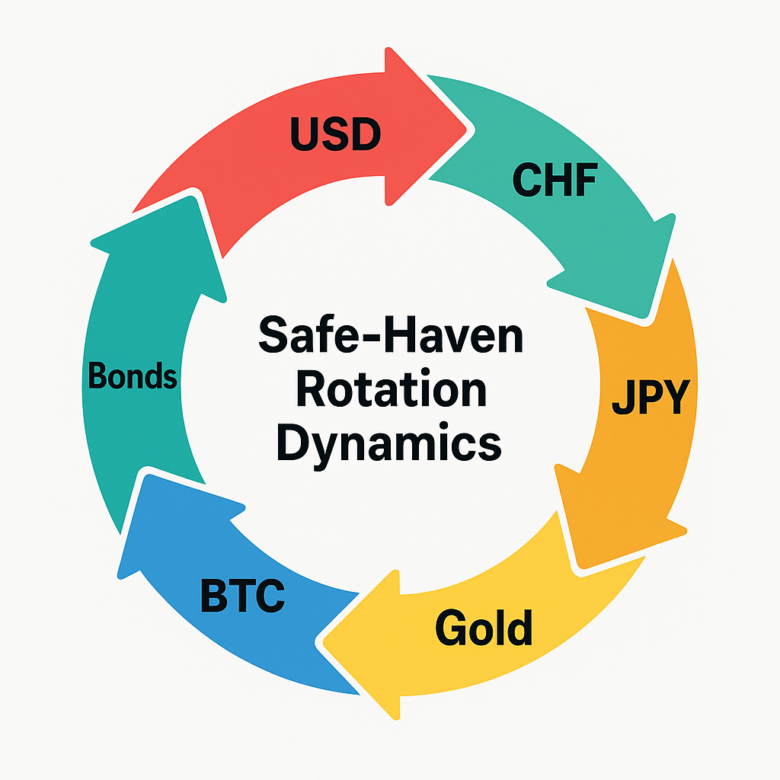
That’s where safe-haven rotation dynamics come in—the idea that money doesn’t just hide under one mattress, it hops between different mattresses depending on the risk lurking in the dark.
Let’s break it down.
Why Safe Havens Exist
Think of traders like cats. They’re curious and adventurous most of the time, but the second something spooks them, they sprint under the couch. Safe havens are the couch.
When fear hits—be it a financial crisis, political drama, or inflation running hotter than a jalapeño—capital doesn’t disappear. It rotates into assets seen as safer, more stable, or less likely to implode.
But here’s the kicker: what counts as “safe” changes depending on the type of threat.
Safe-Haven Currencies
U.S. Dollar (USD)
The dollar is the world’s “break glass in case of emergency” asset. When liquidity dries up, everyone scrambles for dollars.
- Best use: Global crises (2008, COVID crash).
- Catch: If the Fed leans dovish, the dollar can lose its shine.
Japanese Yen (JPY)
The yen rallies when risk assets fall, thanks to Japan’s huge creditor status and carry-trade unwinds.
- Best use: Stock sell-offs and risk-off swings.
- Fun fact: It’s quiet until suddenly it’s not.
Swiss Franc (CHF)
The franc thrives in European or political flare-ups, with Switzerland’s neutrality making it a safe hideout.
- Best use: Eurozone drama, geopolitical jitters.
- Catch: The SNB sometimes reins it in.
For more on Safe Haven Currencies, check out our Forexpedia for more information on their tendencies in different environments!
Safe-Haven Commodities
Gold
Good old gold—shiny, heavy, and impossible to hack. It’s been a safe haven for millennia, which is longer than most currencies can brag about.
- Best environment: Inflation fears, currency debasement, geopolitical shocks.
- Think: When traders start muttering “money printer go brrr.”
- Weak spot: Gold doesn’t pay interest. If bonds offer high yields, gold loses a bit of sparkle.
Bitcoin (BTC)
Enter the rebel. Bitcoin has been branded “digital gold,” but it’s still figuring out its role. Sometimes it rallies when inflation’s hot, sometimes it craters with stocks.
- Best environment: Fiat currency distrust, capital flight from weak economies, long-term inflation hedges.
- Think: Turkey, Argentina, or when Reddit convinces everyone fiat is doomed.
- Caveat: Bitcoin’s volatility is like a roller coaster—you don’t strap in for safety, you strap in for thrills. Not always the best place to hide when markets implode, but it can work well when trust in the current financial system flies out the window.
Bonds (Especially U.S. Treasuries)
U.S. Treasuries are like the vanilla ice cream of safe havens. They’re boring, predictable, and everybody trusts them. When recession fears hit, investors pile in, pushing yields lower.
- Best environment: Deflationary shocks, global recessions, flight-to-quality panics.
- Think: 2008 crisis, 2020 lockdowns.
- Limitation: If inflation is the monster under the bed, bonds aren’t much help—they lose value fast.
How Rotation Dynamics Work
Here’s the fun part: safe havens don’t all shine at once. They rotate depending on the flavor of the risk.
- Banking/credit crisis? USD & Treasuries usually win.
- Stock market tantrum? JPY & CHF tend to rally.
- Inflation surge or currency debasement fears? Gold (and maybe BTC) take the crown.
- Geopolitical flare-ups? Gold and CHF often carry the load.
Think of it like a relay race. When one runner (asset) gets tired or doesn’t fit the current track conditions, the baton passes to another. Traders who spot the baton pass early can position themselves before the crowd.
The Current Safe-Haven Scene (August 2025)
So where are traders hiding right now? The short answer: it’s complicated.
 The past week was dominated by Fed policy uncertainty. Powell’s Jackson Hole speech signaled worries about a slowing U.S. labor market, and traders quickly boosted bets on a September rate cut. That sparked a dollar selloff late in the week, even though earlier sessions had shown the greenback flexing on hawkish Fed chatter and strong data. In other words: USD’s role as “cash is king” safe haven looks shaky when the market thinks the Fed’s ready to cut.
Instead, classic safe havens like the Swiss franc and Japanese yen stepped up. Both CHF and JPY finished the week as top performers, benefiting from political drama (Trump calling for a Fed official’s resignation didn’t exactly calm nerves) and the dovish Fed pivot. Traders clearly wanted currencies with less policy drama attached.
Gold, on the other hand, struggled earlier when yields popped higher, but Powell’s dovish tilt reignited demand. Inflation and rate-cut speculation remain strong tailwinds, so the yellow metal still has a solid fan base.
As for bonds, U.S. Treasuries saw classic “flight-to-quality” action midweek, with yields dropping when political uncertainty spiked. But strong economic data (like PMIs) reminded everyone that inflation isn’t dead, limiting their safe-haven glow.
And Bitcoin? Let’s just say it’s not winning any “reliable safe haven” awards this month. While some investors talk up the “digital gold” angle, its volatility and tendency to follow risk assets kept it from shining during this policy-driven roller coaster.
Bottom line: right now, the rotation baton is in the hands of CHF, JPY, and (to a lesser extent) gold. The dollar may come back if conditions flip to full-blown liquidity panic, but with markets sniffing rate cuts, traders are leaning into other havens for protection.
Key Takeaways for Traders
- Safe havens aren’t universal. Each has its sweet spot.
- Match the risk to the asset. Is it inflation? Deflation? Political risk? Liquidity crunch? That determines where capital flows.
- Correlations shift. Just because something acted as a safe haven once doesn’t mean it always will. Stay flexible.
- Rotation happens fast. By the time you see it on the chart, big players may already be halfway through the move.
Wrapping It Up
Safe-haven rotation dynamics might sound like an Ivy League finance course, but at the core, it’s simple: markets get scared, money looks for safety, and the definition of “safety” depends on the threat of the day.
For new traders, the trick is not memorizing “X always goes up when Y goes down.” Instead, learn to read the environment. Ask yourself: What’s the market afraid of right now? The answer will often tell you which safe haven is about to shine.
Because in trading, safety isn’t about finding the one perfect couch to hide under. It’s about knowing which couch all the other cats are running to.