
Gold (XAU/USD) attracts some dip-buying at the start of a new week and stalls Friday’s modest pullback from the $4,260 area, or the vicinity of its highest level since October 21. The US Dollar (USD) continues with its struggle to attract any meaningful buyers and languishes near a one-month low amid dovish Federal Reserve (Fed) expectations. This turns out to be a key factor acting as a tailwind for the non-yielding yellow metal during the Asian session.
The commodity, however, remains confined in a familiar range held over the past week or so as traders opt to wait for the crucial FOMC rate decision on Wednesday. The focus will be on the updated economic projections, including the so-called dot plot, and Fed Chair Jerome Powell’s comments at the post-meeting press conference. Investors will look for cues about the Fed’s rate-cut path, which should provide a fresh impetus to the buck and the XAU/USD pair.
Daily Digest Market Movers: Gold continues to draw support from dovish Fed-inspired USD weakness
- A delayed report published by the US Commerce Department on Friday showed that the Personal Consumption Expenditures (PCE) Price Index rose 2.8% on a yearly basis in September, matching consensus estimates.
- The core PCE Price Index, the Federal Reserve’s preferred inflation gauge, rose 2.8% in September compared to 2.9% in August. Moreover, signs of a cooling US labor market back the case for more easing by the Fed.
- According to the CME Group’s FedWatch Tool, traders are pricing in a nearly 90% chance that the Fed will lower borrowing costs again this week and a greater chance of another rate reduction by April next year.
- The dovish outlook fails to assist the US Dollar to register any meaningful recovery from its lowest level since late October and revives demand for the non-yielding yellow metal during the Asian session on Monday.
- Russia carried out a massive missile-drone attack on power stations and other energy infrastructure in Ukraine. Moreover, slow progress in the Russia-Ukraine peace talks benefits the safe-haven XAU/USD pair.
- Despite the supporting factors, bullish traders seem reluctant to place aggressive bets around the commodity and opt to wait for the outcome of the highly anticipated two-day FOMC policy meeting on Wednesday.
- Given that a 25 basis point rate cut is nearly fully priced in, investors will look for more cues about the Fed’s future policy path. This will play a key role in providing a fresh impetus to the USD and the commodity.
Gold needs to break out through a one-week-old range before the next leg of a directional move
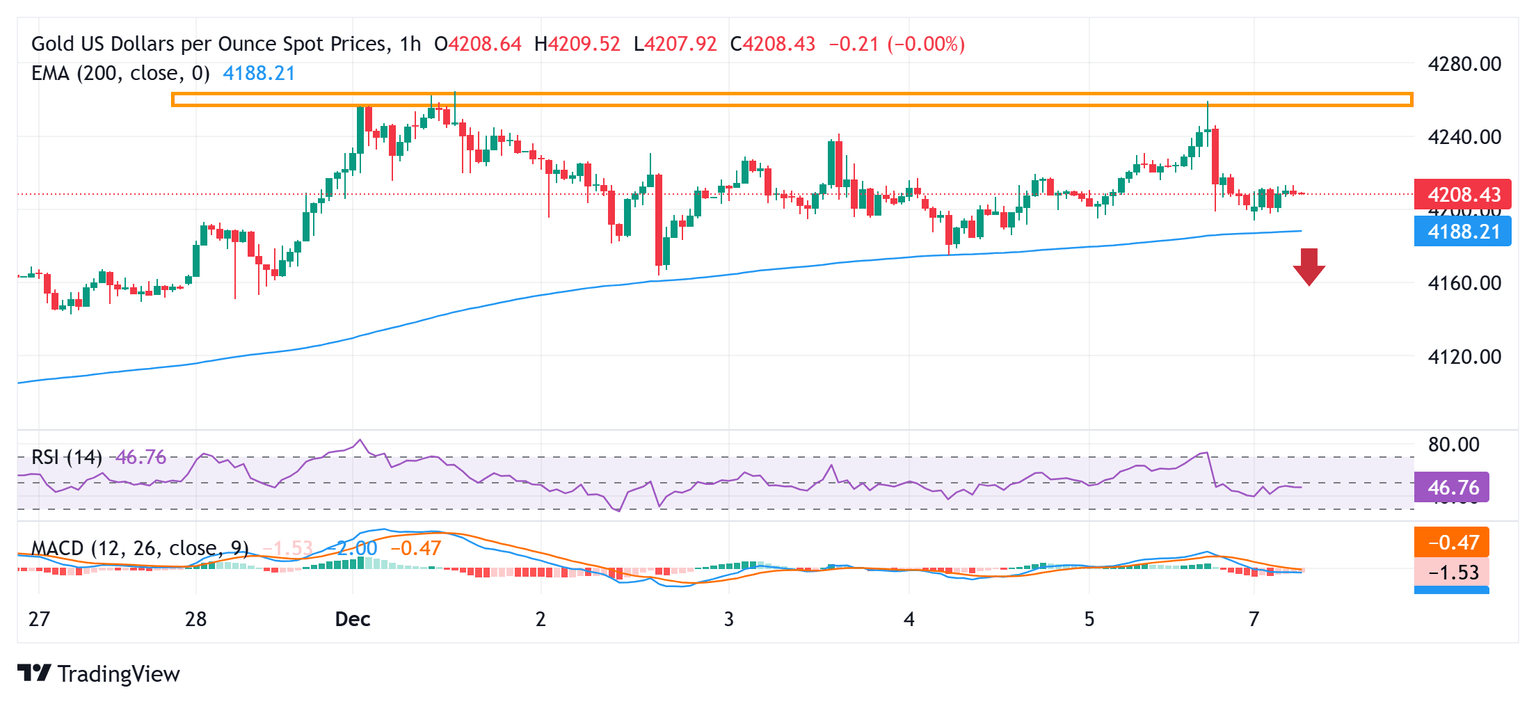
The 200-hour Exponential Moving Average (EMA) has been offering some support to the XAU/USD pair since the beginning of this month. The said support is currently pegged near the $4,190 area and should act as a key pivotal point for short-term traders. A convincing break below might prompt some technical selling and make the Gold price vulnerable to accelerate the fall towards the $4,164-4,163 region, or the monthly swing low, en route to sub-$4,100 levels. The latter represents a short-term ascending trend-line extending from late October, which, if broken decisively, will be seen as a fresh trigger for bearish traders and pave the way for deeper losses.
On the flip side, the $4,250-4,260 region might continue to act as an immediate strong barrier. A sustained strength beyond could lift the Gold price to the next relevant hurdle near the $4,277-4,278 area before the bullion aims to reclaim the $4,300 mark. Some follow-through buying will be seen as a key trigger for the XAU/USD bulls and pave the way for the resumption of the uptrend witnessed since the late November swing low.
Gold FAQs
Gold has played a key role in human’s history as it has been widely used as a store of value and medium of exchange. Currently, apart from its shine and usage for jewelry, the precious metal is widely seen as a safe-haven asset, meaning that it is considered a good investment during turbulent times. Gold is also widely seen as a hedge against inflation and against depreciating currencies as it doesn’t rely on any specific issuer or government.
Central banks are the biggest Gold holders. In their aim to support their currencies in turbulent times, central banks tend to diversify their reserves and buy Gold to improve the perceived strength of the economy and the currency. High Gold reserves can be a source of trust for a country’s solvency. Central banks added 1,136 tonnes of Gold worth around $70 billion to their reserves in 2022, according to data from the World Gold Council. This is the highest yearly purchase since records began. Central banks from emerging economies such as China, India and Turkey are quickly increasing their Gold reserves.
Gold has an inverse correlation with the US Dollar and US Treasuries, which are both major reserve and safe-haven assets. When the Dollar depreciates, Gold tends to rise, enabling investors and central banks to diversify their assets in turbulent times. Gold is also inversely correlated with risk assets. A rally in the stock market tends to weaken Gold price, while sell-offs in riskier markets tend to favor the precious metal.
The price can move due to a wide range of factors. Geopolitical instability or fears of a deep recession can quickly make Gold price escalate due to its safe-haven status. As a yield-less asset, Gold tends to rise with lower interest rates, while higher cost of money usually weighs down on the yellow metal. Still, most moves depend on how the US Dollar (USD) behaves as the asset is priced in dollars (XAU/USD). A strong Dollar tends to keep the price of Gold controlled, whereas a weaker Dollar is likely to push Gold prices up.