The European Central Bank (ECB) kept its deposit rate unchanged at 2.00% on Thursday for a fourth consecutive meeting, maintaining its pause in the easing cycle that saw eight rate cuts between June 2024 and June 2025.
The unanimous decision came as the ECB upgraded its economic growth forecasts and projected inflation to stabilize around the 2% target through 2028, reinforcing market expectations that further rate cuts are off the table for the foreseeable future.
Key Takeaways
- ECB held all three key rates unchanged: deposit rate at 2.00%, main refinancing at 2.15%, marginal lending at 2.40%
- Decision was unanimous, marking fourth consecutive pause since June 2025
- Inflation projections: 2.1% in 2025, 1.9% in 2026, 1.8% in 2027, 2.0% in 2028; Core inflation at 2.4% in 2025, 2.2% in 2026, 1.9% in 2027, 2.0% in 2028
- Growth projections upgraded: 1.4% in 2025 (up from 1.2%), 1.2% in 2026, 1.4% in 2027 and 2028
- Inflation revised higher for 2026 due to slower decline in services prices driven by stronger wage growth
- President Lagarde said ECB remains “in a good place” with “all optionalities on the table“
- Growth drivers: AI investment from both public and private sectors, surprisingly strong pharmaceutical exports
- ECB maintains data-dependent, meeting-by-meeting approach with no pre-commitment to rate path
Link to official ECB Monetary Policy Statement (December 2025)
In her press conference, ECB President Christine Lagarde maintained the central bank’s cautious stance, repeating that policymakers remain “in a good place” while emphasizing this position is “not static.” The statement removed previous references to the outlook being “uncertain,” representing a mildly hawkish shift in tone.
Lagarde highlighted two factors that have surprised the ECB on the upside: investment spending driven largely by AI development from both large corporations and SMEs, and resilient exports despite the tariff environment, particularly in pharmaceuticals. She specifically mentioned weight loss drugs as an example of surprisingly strong export performance.
The upgraded inflation forecast for 2026 stems from expectations that services inflation will decline more slowly than previously anticipated, driven by wage growth that has exceeded ECB projections. Despite inflation projected to dip below the 2% target in 2026 and 2027, Lagarde emphasized that the Governing Council unanimously agreed to keep “all optionalities on the table” and maintain a meeting-by-meeting approach.
When asked about the next rate move, Lagarde avoided signaling direction, stating there was “no set date for any move” and that the ECB “simply cannot offer forward guidance” given elevated uncertainty.
Link to ECB Governing Council Press Conference (December 2025)
Market Reactions
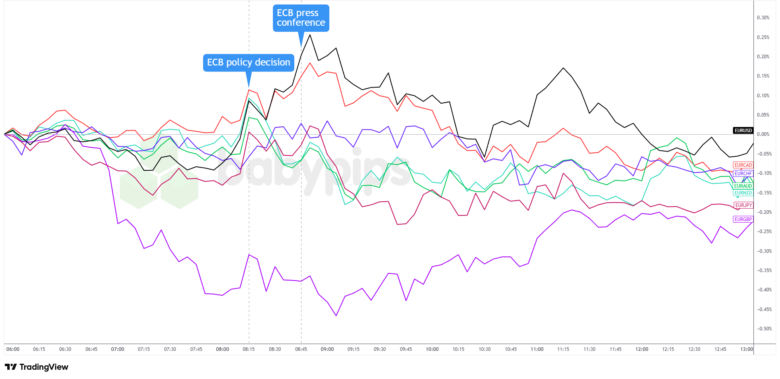
Euro vs. Major Currencies: 5-min

Overlay of EUR vs. Major Currencies Chart by TradingView
The euro leaned bearish through the early London session, then popped modestly higher right after the rate announcement. That move likely reflected relief that the decision landed exactly as expected and that the ECB dropped the word uncertain from its statement.
EUR caught another bid during Lagarde’s press conference, but the rally did not last. As traders digested the ECB’s balanced tone and shifted focus back to weak U.S. inflation data, the euro’s gains quickly faded.
For the rest of the session, the shared currency drifted back to a bearish lean, except for moves against the dollar and the pound. By the end of the day, the euro finished broadly lower against most major currencies, even with the ECB upgrading its economic projections.
The muted reaction, followed by selling, likely reflected a few things coming together. Markets had already priced in the idea that the easing cycle is probably over, Lagarde’s focus on optionality offered little in the way of clear forward guidance, and projections showing inflation below target in 2026 and 2027 kept the door open to future cuts if conditions deteriorate.
The euro’s underperformance was also shaped by broader market dynamics, including year-end positioning and some profit-taking after a strong run earlier in 2025.
Taken together, price action suggests markets read the ECB’s balanced message as less hawkish than some had expected after recent comments from board member Isabel Schnabel that hinted the next move could eventually be a hike.